Select an image or table to view it at full size in a new tab.
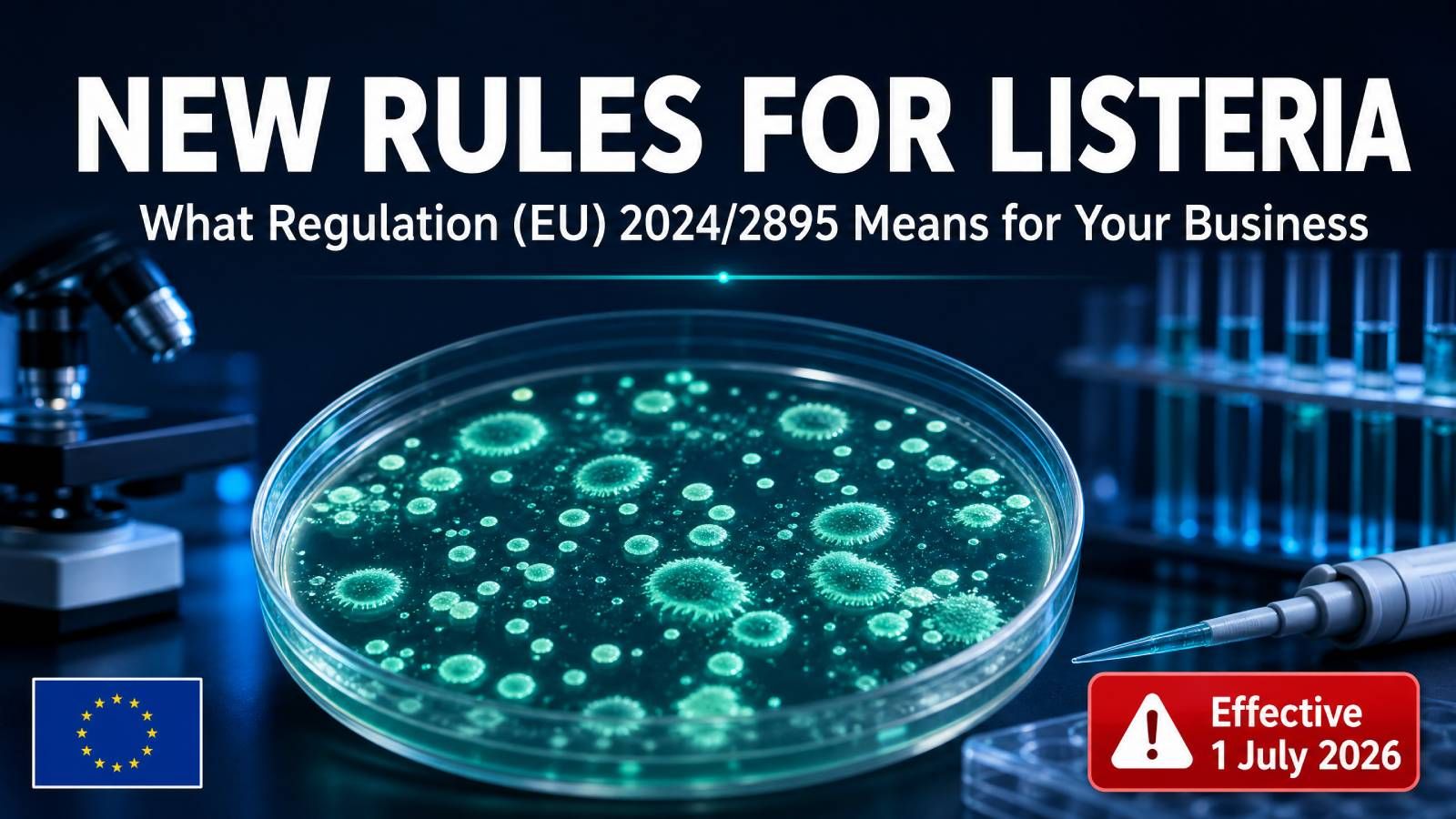
The European Union adopted the new Regulation (EU) 2024/2895 on 20 November 2024, significantly tightening the microbiological criteria for the presence of Listeria monocytogenes in ready-to-eat (RTE) food.
This change, which entered into force on 1 July 2026, was driven by a sharp rise in listeriosis cases across Europe.
According to a report by the European Food Safety Authority (EFSA), the number of listeriosis cases in the EU in 2022 increased by nearly 16% compared to the previous year, with one of the highest death tolls recorded in the last decade.
What Exactly Is Changing?
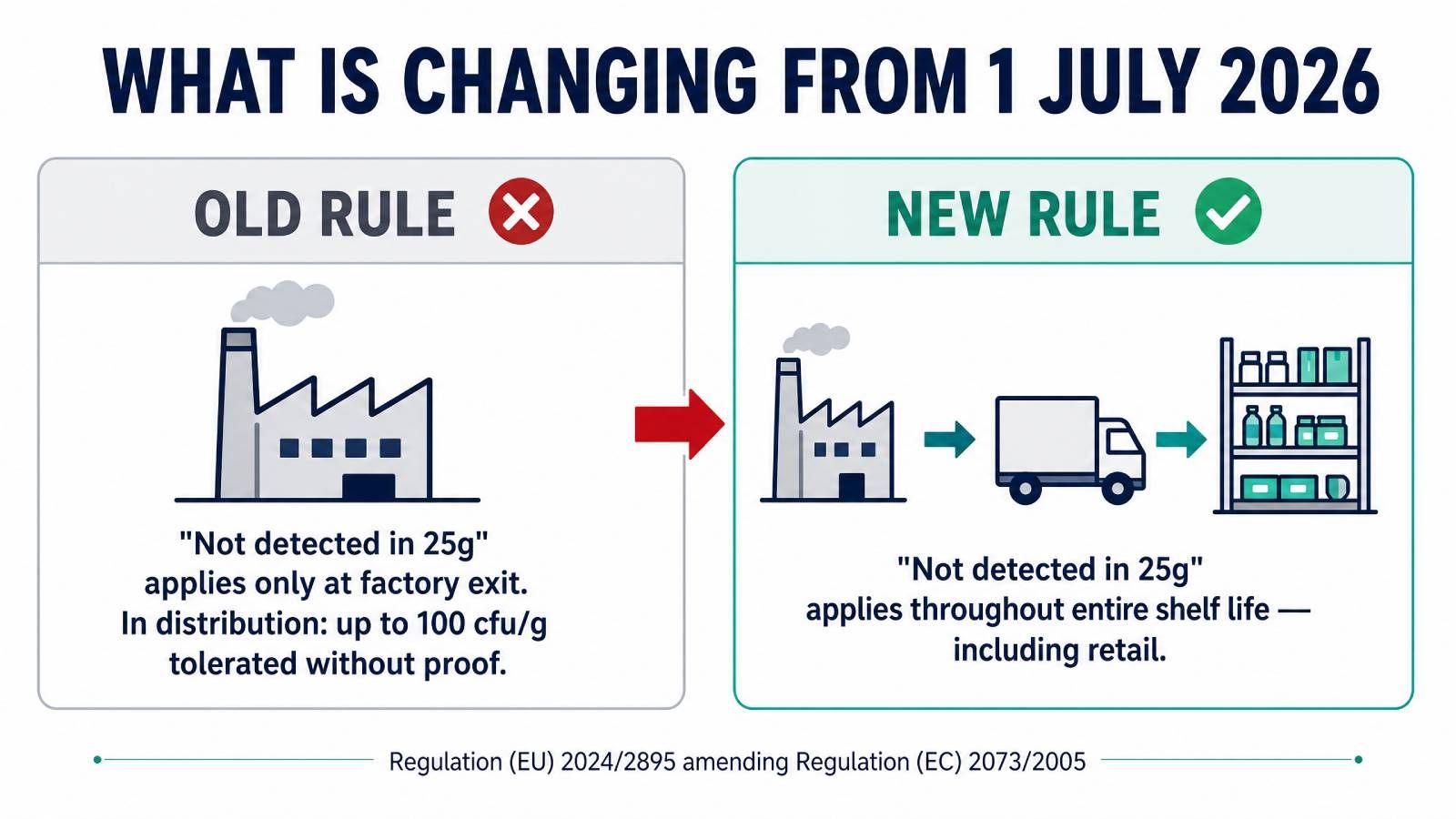
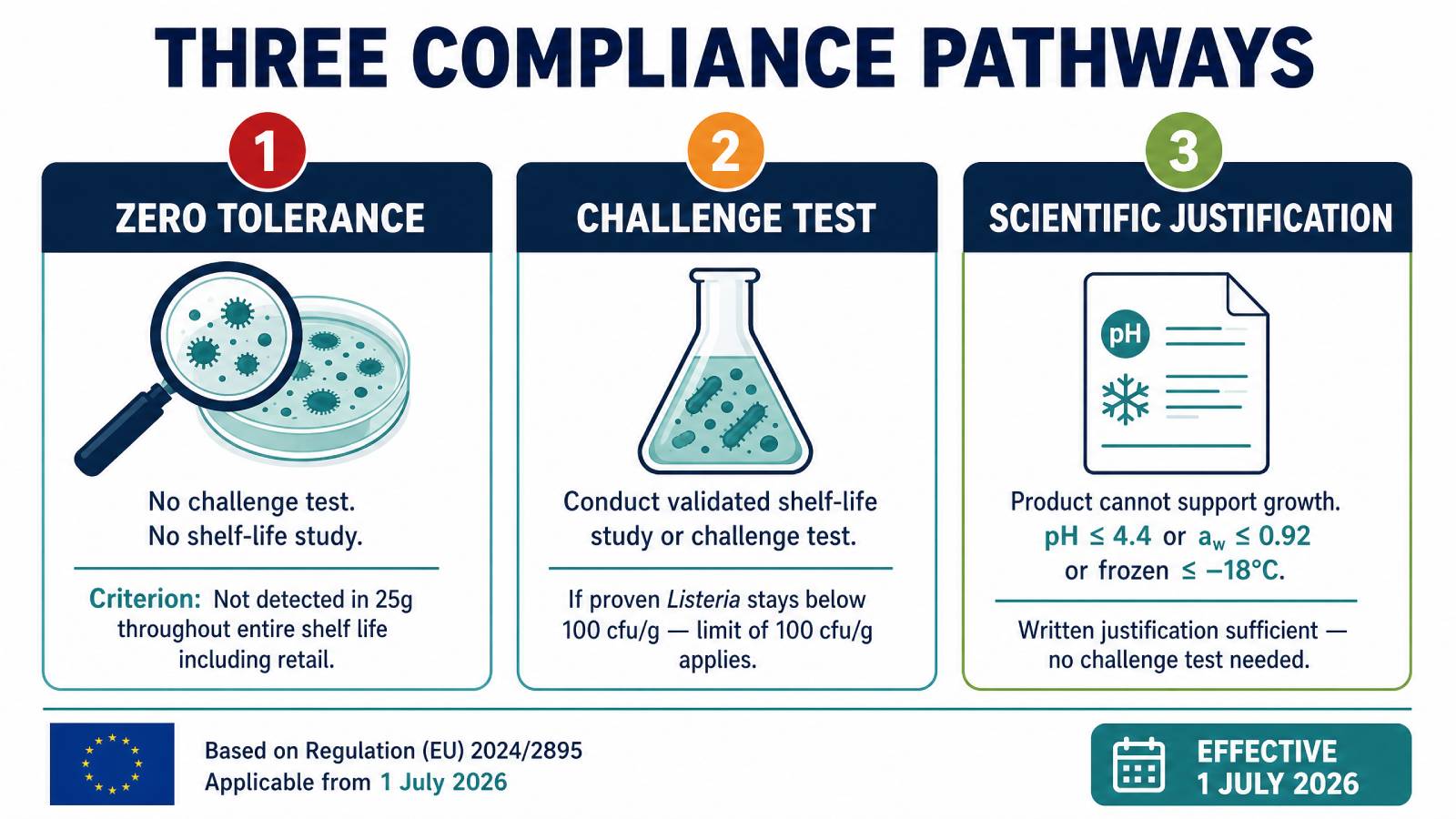
Until now, under Regulation 2073/2005, the rule "not detected in 25 g" applied only while the product was under the direct control of the manufacturer. Once the product left the facility, the presence of Listeria up to 100 cfu/g was tolerated throughout the shelf life, unless the manufacturer could prove otherwise.
The new Regulation changes this paradigm. From 1 July 2026, the criterion "not detected in 25 g" will apply throughout the entire shelf life and across the entire distribution chain (including retail) for all RTE food that supports the growth of this bacterium, unless the manufacturer has a validated proof that the level of Listeria will not exceed 100 cfu/g by the end of the shelf life.
In practice, this means that if an inspector in a supermarket takes your product on the last day of its shelf life and finds even the slightest presence of Listeria (even below 100 cfu/g), your product will be declared unsafe — unless you have a validated study proving that the level will not exceed the critical threshold.
Case Study: Implementation in Smoked Salmon Production
To illustrate what this looks like in practice, let us look at the example of a fictional company that produces cold-smoked salmon in vacuum packaging with a 30-day shelf life.
Phase 1: Analysis of the Current Situation
The company regularly tests the finished product at the point of dispatch and Listeria has never been detected in 25 g. However, they have not conducted a so-called challenge study (shelf-life testing under challenging conditions). Under the new Regulation, if an inspector in retail finds 10 cfu/g of Listeria in their salmon on day 25 of the shelf life, the entire batch must be recalled, because the company has no proof that the bacterial count will not exceed 100 cfu/g by day 30.
Phase 2: Action Plan
The quality team decides to implement three key steps to prepare for compliance with the Regulation:
1.Environmental Monitoring Program (EMP)
The company intensifies surface swabbing. They focus on "zone 1" (cutting knives, conveyor belts) and "zone 2" (drains, washing equipment). The goal is to detect and eliminate Listeria biofilms before they ever come into contact with the salmon.
2.Shelf-life Validation (Shelf-life study / Challenge test)
The company engages an accredited laboratory to conduct a challenge test. The salmon is deliberately inoculated with a known number of Listeria bacteria, then stored at temperatures simulating real conditions in the supply chain (e.g. 4°C at the facility, 8°C in transport, 12°C in a domestic refrigerator).
3. Recipe Adjustment
During the challenge test, they discover that at 8°C Listeria exceeds the threshold of 100 cfu/g as early as day 22. To maintain the 30-day shelf life, the technologists add natural inhibitors (e.g. lactates and acetates) to the salting process. The repeated test shows that the inhibitors slow growth, and the Listeria level remains below 50 cfu/g even on day 30.
Phase 3: Outcome
With a validated laboratory report, company now has proof that their product, under the intended storage conditions, will not exceed the limit of 100 cfu/g. As a result, under the new Regulation, the limit of 100 cfu/g applies to their product in retail — not the zero-tolerance criterion ("not detected in 25 g").
Third Pathway: Products That Cannot Support the Growth of Listeria
There is also a third, often overlooked pathway explicitly provided for in category 1.3 of Regulation 2073/2005 (as amended by Regulation 2024/2895): RTE food that by its nature cannot support the growth of Listeria monocytogenes. For this category, the limit of 100 cfu/g applies throughout the shelf life — but with no obligation to conduct a challenge test. Instead, a written document providing a scientific justification for why growth is not possible is sufficient.
Which Parameters Prove That Growth Is Not Possible?
According to ECFF (European Chilled Food Federation) guidelines and scientific literature, the growth of Listeria monocytogenes is biologically impossible when one or more of the following conditions are met: water activity (aw) ≤ 0.92; pH value ≤ 4.4; the combination of pH ≤ 5.0 AND aw ≤ 0.94 simultaneously; storage temperature ≤ −1.5°C (frozen); or shelf life ≤ 5 days at a temperature ≤ +8°C.
What Are the Specific Product Groups?
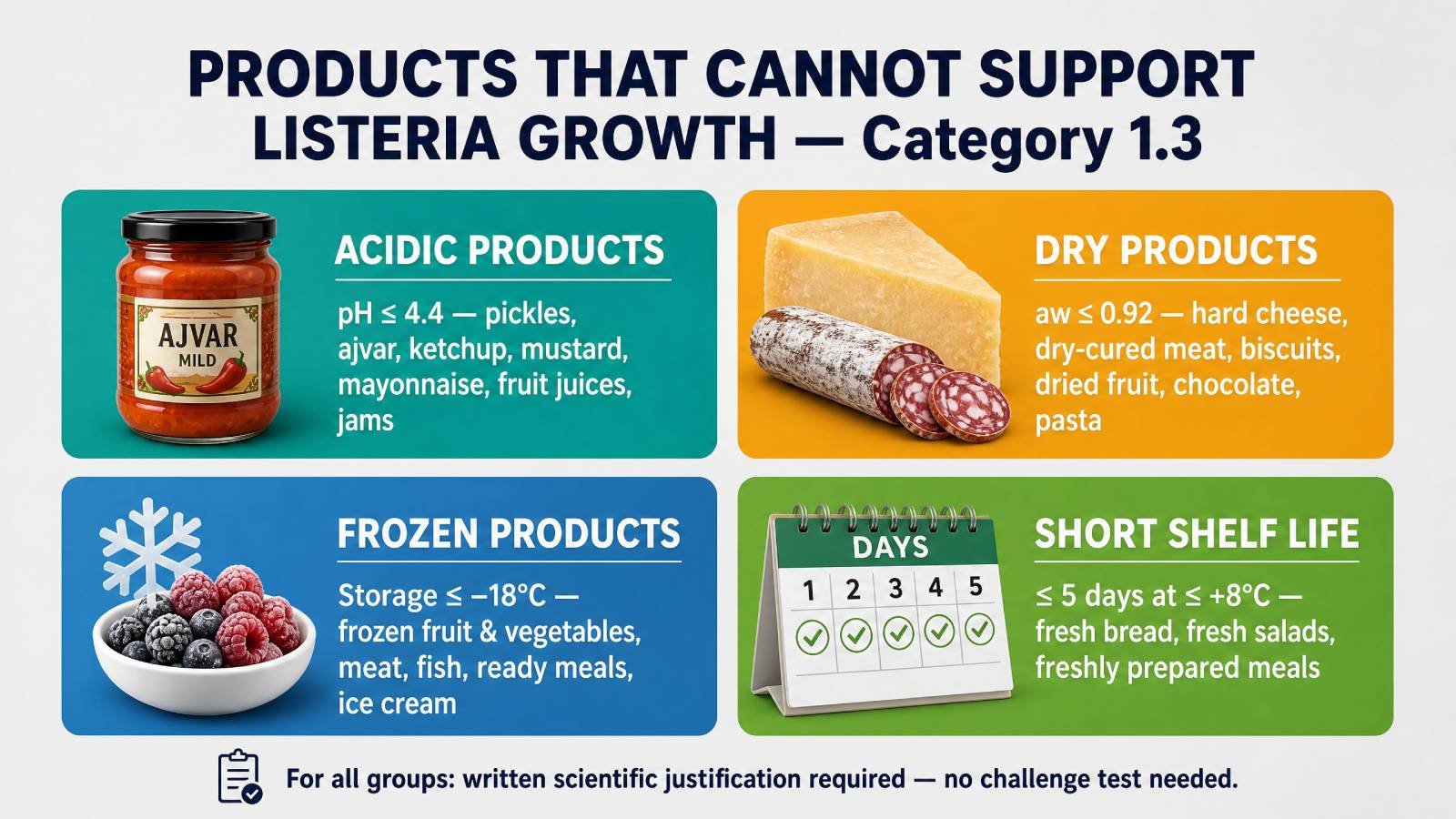
Acidic Products (pH ≤ 4.4)
This is the most common and most important category in the Serbian food industry. It includes: ajvar and other acidic vegetable spreads (with vinegar), pickled cucumbers and mixed pickles, ketchup and mustard, mayonnaise, fruit jams and marmalades with high acid content, fruit juices (pH < 4.4), fermented sausages with pH below 4.4, and all other RTE products whose pH consistently remains below 4.4 throughout the shelf life. For these products, it is sufficient to document regular pH measurements from internal quality control and cite a scientific reference (e.g. ECFF guidelines) confirming that Listeria cannot grow below pH 4.4.
Dry Products (aw ≤ 0.92)
This includes: dry sausages and cured meats (shelf-stable charcuterie), hard cheeses such as parmesan, biscuits, rusks and breadsticks, dried fruit and nuts, chocolate and chocolate products, dried pasta and all other dry RTE foods with aw below 0.92. For these products, the scientific justification is based on measured aw values in the final product, supported by a reference to scientific literature.
Frozen Products (Storage Temperature ≤ −18°C)
This is the simplest category: all frozen RTE products stored at ≤ −18°C automatically fall into category 1.3. Growth of Listeria is impossible below −1.5°C, so the scientific justification is straightforward. It includes: frozen fruit and vegetables, frozen meat and fish, frozen ready meals, ice cream and all other frozen RTE foods.
Note: this category applies only while the product is in a frozen state — if the label states that the product may also be consumed after thawing, the thawed product must be assessed separately.
Products with a Short Shelf Life (≤ 5 Days at ≤ +8°C)
This includes: freshly baked bread and pastries without preservatives, freshly prepared salads and ready meals with a shelf life of up to 5 days, and other fresh RTE foods with a short shelf life. The scientific justification is based on mathematical growth models (e.g. ComBase) showing that even at maximum initial contamination, Listeria cannot reach 100 cfu/g within 5 days at a temperature of up to 8°C.
What Does a Scientific Justification Look Like in Practice?
A scientific justification is a written document (typically one to three pages) containing: a description of the product and its RTE classification; measured values of key physicochemical parameters (pH, aw, salt content) on the final product in a worst-case scenario; a reference to scientific literature or a regulatory document confirming that Listeria cannot grow at those values; and a conclusion classifying the product in category 1.3.
Key Note: Consistency of Parameters
The scientific justification must be based on worst-case values — i.e. the upper boundary of pH or aw that occurs in regular production, not on average values. If the pH of ajvar is 4.3 in some batches and 4.6 in others, you cannot claim that the product consistently falls into category 1.3. In that case, the solution is either to adjust the recipe so that the pH consistently remains below 4.4, or to follow one of the first two pathways (challenge test or zero tolerance).
What Should Your Company Do Today?
Categorise your products:
Identify which of your products fall into RTE food that supports the growth of Listeria (pH > 4.4, aw > 0.92).
Review your documentation:
Do you have valid, laboratory-confirmed shelf-life studies for those products?
Improve facility hygiene:
Listeria is an environmental bacterium. Your best ally is an aggressive and well-designed environmental monitoring programme (EMP).
Do not wait for the new rules to take effect. Being proactive today means avoiding costly product recalls and reputational damage tomorrow.For any doubts, you can contact our Agency for help!!!