Select an image or table to view it at full size in a new tab.
If you work in the food industry, you are probably well acquainted with the list of 14 mandatory allergens under Regulation (EU) No 1169/2011. But what you may not know is that this list — unchanged since 2011 — is on the verge of the biggest revision in its history. In parallel, the European Commission is preparing an entirely new regulatory framework for so-called Precautionary Allergen Labelling (PAL), which will permanently change the way you write warnings such as “may contain traces of...”.
In this article, we provide an overview of all the key changes, with references to the specific regulatory initiatives currently under way.
Why Is Regulation That Has Been Working for 15 Years Being Changed?
The answer is simple: science has moved on and the world has changed. The list of 14 allergens defined in 2011 was based on the epidemiological data available at the time. Since then, the number of diagnosed allergies in the EU has risen dramatically — according to EFSA (the European Food Safety Authority), food allergies affect more than 10% of the world's population, and approximately 4.5 million people in the EU are estimated to suffer from them.
A study published in September 2025 in the scientific journal Clinical and Experimental Allergy, based on data from France, Belgium and Luxembourg from 2002 to the present, showed that as many as 37.9% of all food-induced anaphylaxis cases are not covered by any of the 14 currently regulated allergens. This is a scientific argument that cannot be ignored.
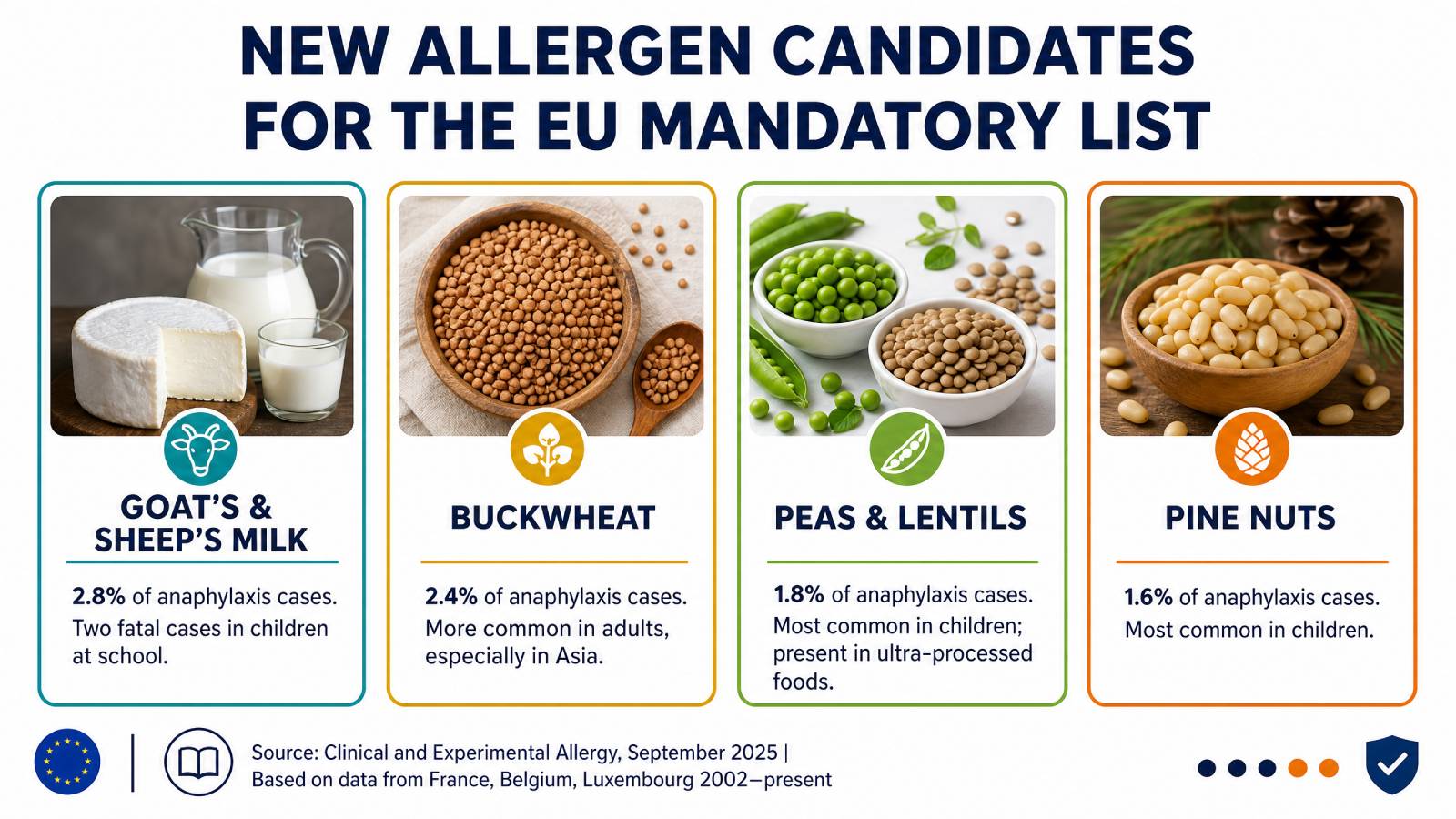
Which New Allergens Are on the Candidate List?
Based on the aforementioned study and EFSA scientific opinions, four foods have been identified as priority candidates for addition to the mandatory list:
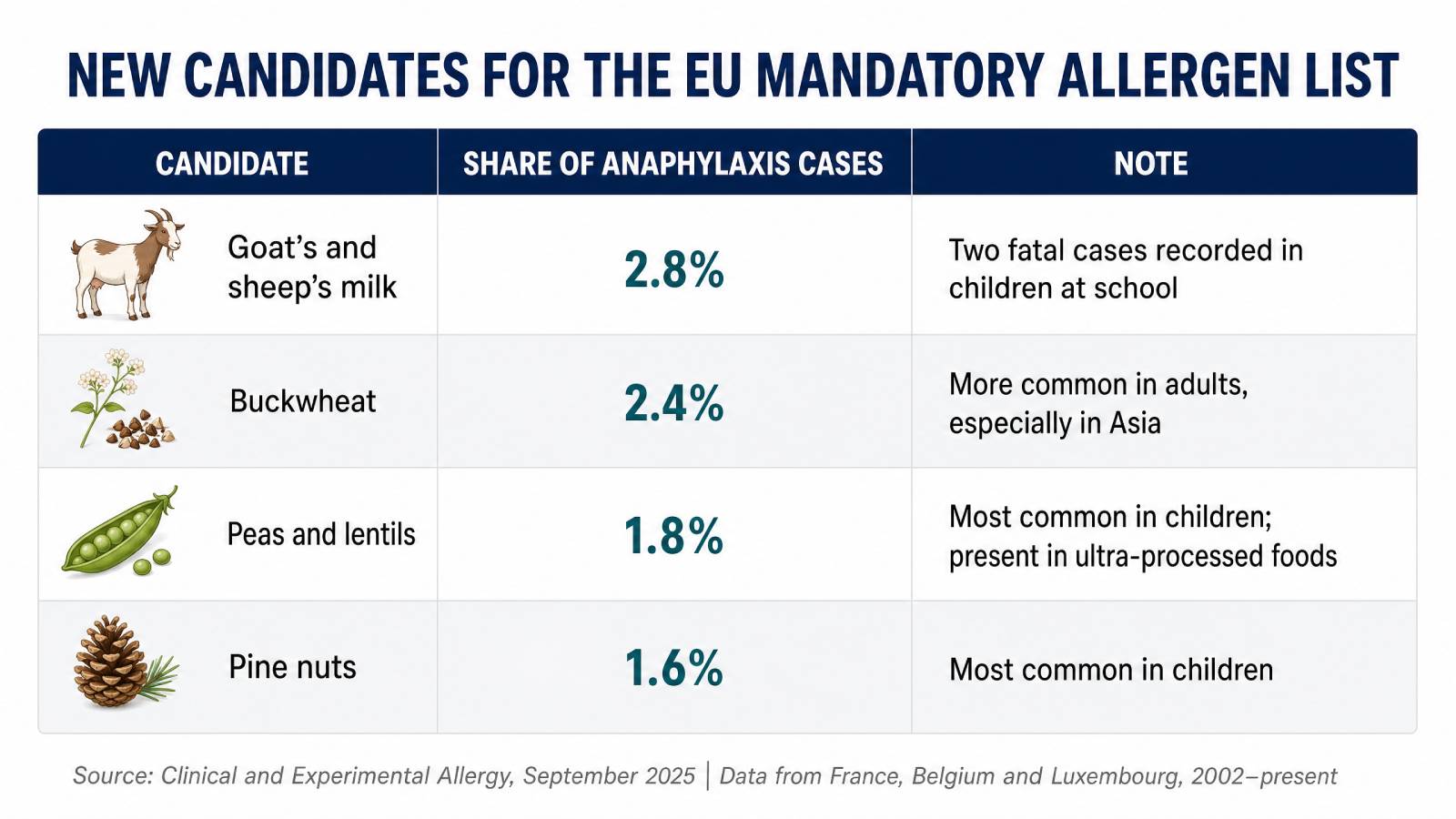
Particularly concerning is the finding that goat's and sheep's milk are responsible for more anaphylaxis cases than two of the 14 currently regulated allergens — mustard and sulphites. In addition, the study identified four further foods (kiwi, apple, beehive products and the alpha-gal molecule from red meat) that are associated with anaphylaxis but were assessed as more easily avoidable and therefore not proposed for mandatory regulation.
It is important to emphasise that the official amendment to the list of 14 allergens has not yet been adopted — but the scientific basis for expanding the list exists and the Commission is obliged to review it periodically.
The Biggest Change: Regulating "May Contain Traces of..." (PAL)
This is the change that will have the most profound practical consequences for the food industry. It concerns the regulation of so-called Precautionary Allergen Labelling — PAL — the warnings placed on packaging when there is a risk of unintentional allergen contamination during production.
The Current Situation — Chaos That Harms Everyone
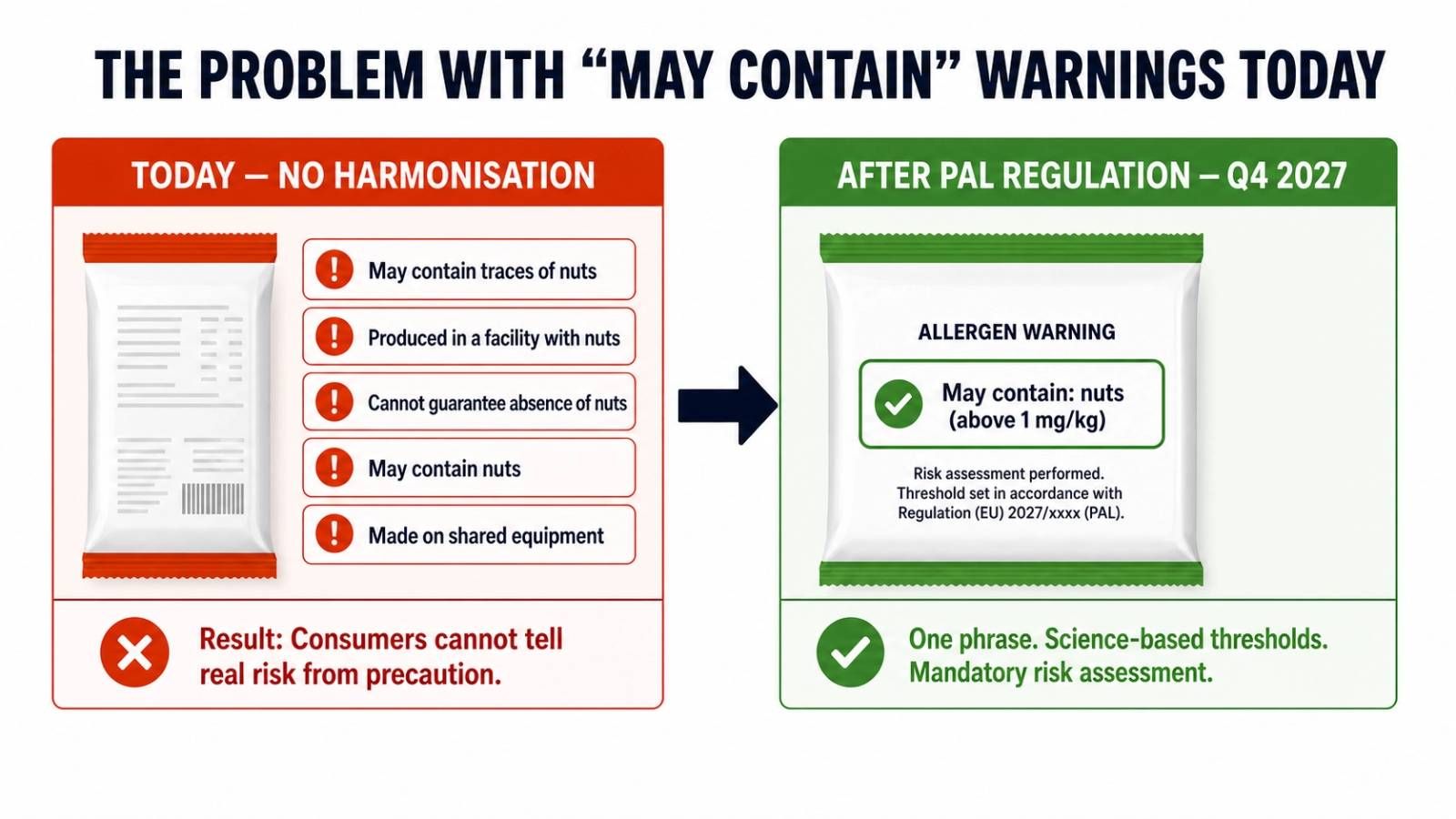
Today in the EU there is no legal provision regulating when, how or even whether a PAL warning should be placed on packaging. Each manufacturer does so at their own discretion. The result is a proliferation of warnings: many manufacturers place "may contain traces of..." on every product, even when the risk is negligible, in order to protect themselves from liability. This means that allergic individuals cannot distinguish a real risk from a precautionary statement, which drastically narrows their food choices.
What Is the Commission Planning?
On 27 February 2026, the European Commission officially published a draft act on its Better Regulation Portal, announcing the preparation of an Implementing Regulation on harmonised PAL requirements. According to this publication, adoption of the regulation is planned for the fourth quarter of 2027.
This regulation is expected to:
1. Introduce mandatory thresholds for unintentional allergen presence, below which a PAL warning is not required and above which it is mandatory.
2. Standardise the wording of warnings — one official phrase for the entire EU, instead of the dozens of different variants that currently confuse consumers.
3. Require manufacturers to carry out a formal cross-contamination risk assessment before placing or omitting a PAL warning — meaning that "we add the warning just in case" will no longer be acceptable.
The scientific basis for thresholds already exists: EFSA published a scientific opinion on allergen reference doses (so-called eliciting doses — ED01) in 2022, and the FAO and WHO have developed a science-based framework for risk-based PAL labelling within the Codex Alimentarius system.
What Does This Mean for Manufacturers?
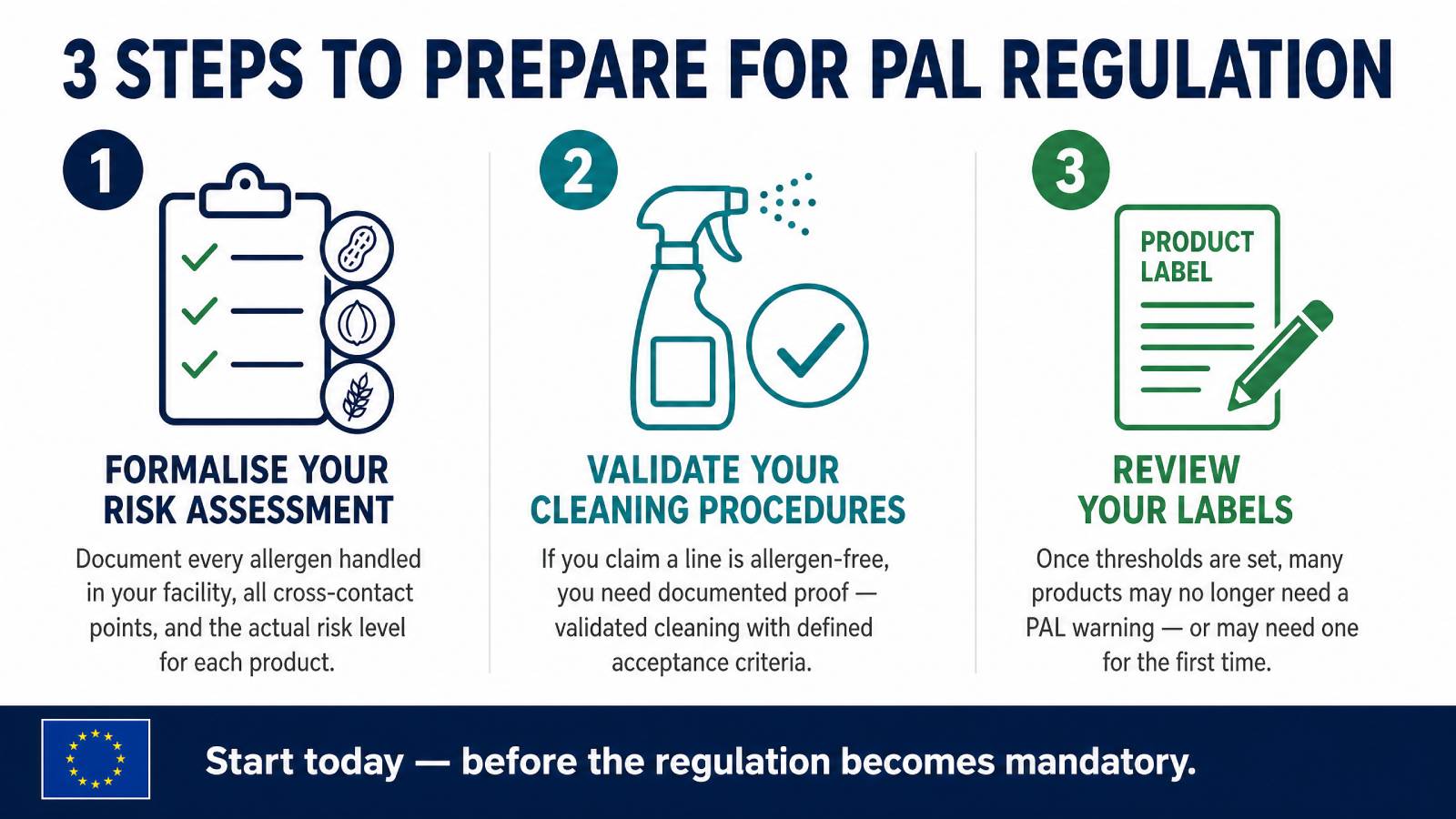
In concrete terms, preparing for PAL regulation requires three key steps.
First, formalising the cross-contamination risk assessment: every facility must document which allergens it handles, what the points of cross-contact are, and what the actual risk is for each product. This is not merely a paperwork requirement — it is the basis for deciding whether a PAL warning should or should not appear on the label.
Second, validating cleaning procedures: if you claim that the line has been cleared of allergens and that a PAL warning is not required, you must have proof — a validated cleaning procedure with defined acceptance criteria.
Third, reviewing labels: once thresholds are defined, many products that currently carry a PAL warning may not need one — and vice versa.
Conclusion: The Time to Prepare Is Now
The upcoming regulatory changes in the field of allergens are not a question of “whether” — only of “when”.
Companies that begin adapting their allergen management systems today — before the regulations become mandatory — will be in a significantly better position than those that wait until the last moment.
Conduct your risk assessments and implement the necessary preventive measures. If you need assistance, please do not hesitate to contact our Agency.