
Select an image or table to view it at full size in a new tab.
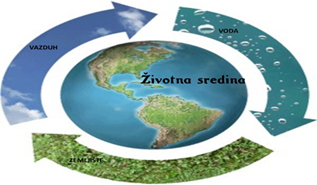
The term “environment” is used to describe our natural environment, such as trees, grass, water, air. According to ISO 1400: (clause 3.8) “the environment is the environment in which the organization operates, including air, water, soil, natural resources, flora, fauna, people and their mutual relationships.”
The term “environmental management” means controlling our activities in order to preserve natural resources and prevent their pollution. We can control our activities in all segments of life, starting with what we use and throw away in our households, up to the most important segment of controlling activities within our business environment that have the greatest impact on the environment.
The benefits of environmental protection are:
- ethical: it is our duty to take care of the world and the environment in which we live and to leave it in good condition for our children
- economic: preserving the environment and limiting the generation of waste means lower costs for the organization.
- legal: almost all countries have laws in their legislation that control the impact of companies on the environment.
- Commercial: more and more large companies take care of environmental protection, which they expect from their customers and suppliers. Without an established environmental management system, cooperation with a large number of these companies is not possible.
The Environmental Management System (EMS – Environmental Management System) is that part of the organization’s management that deals with the immediate and long-term impact of its products, processes and services on the environment. This ensures order and consistency in the way of organization through the distribution of resources, work tasks and continuous evaluation of work, procedures and processes. The environmental protection management system should follow the following principles:
- establishing an adequate environmental protection policy, including commitment to pollution prevention
- choose to comply with legal regulations and align with the organization’s activities, products and services
- develop the commitment of management and employees to the preservation of the environment with clear tasks and responsibilities
- encourage planning related to environmental protection through all activities of the organization, from the procurement of raw materials to the placement of the final product
- Establish management procedures that achieve set goals
- provide necessary and sufficient resources, including training, in order to achieve the set goals
- establish and maintain an emergency response program
- review the effects related to environmental protection policies and objectives and introduce improvements where necessary
- establish and maintain good communication with external and internal stakeholders
- encourage customers and suppliers to implement EMS
Unfortunately, accidents caused by the harmful effects of human activities on the environment led to the development of environmental protection standards. Thus, the large pollution of Lake Erie by the American paper production company led to the establishment of the Environmental Protection Agency of the United States of America in 1970. A gas leak at a pesticide production company in Bhopal, India, in 1984, led to consideration of the environmental impact of chemical industry companies in countries (especially in the third world). The gas accident took a large number of human lives, employees of the company as well as people from the company’s environment. Established environmental protection management system:
- 1988: The American Chemistry Council (ACC-American Chemistry Council) published the Responsible Care guide, which provided guidelines for improving the company’s performance in establishing measures that take into account the protection of the environment and the health of the community within which the company operates. does business
- 1992. : The British Standards Institute (BSI -British Standards Institute) has published the world’s first environmental management system standard, BS 7750, a standard for environmental control in the manufacturing and service sectors
- 1993. : established the EMAS scheme (The Eco Management and Audit Scheme), by means of which industrial producers from the European Union prove the management’s commitment to the preservation of the environment
- 1996: The International Organization for Standardization – ISO, adopts the ISO 14001 standard, an international registration scheme compatible with BS 7750 and EMAS, and in accordance with the ISO 9001 quality management standard.
ISO 14001 is a standard that enables the certification of companies related to environmental protection management, it is similar in structure to the quality management standard ISO 9001. The goal of this standard is to help organizations to properly manage their operations that affect the environment, in accordance with current legal regulations. Today, more than 300,000 companies worldwide, in 171 countries, are certified by the ISO 14001 standard.
Environmental protection management system standards
The International Organization for Standardization, ISO, apply great importance to the development of environmental management system standards. In support of this is a large number of standards of the ISO 14000 series, from 14000-14099, which are related to the environment. A large number of these standards have already been published and others are in the process of preparation. The most important standards of the ISO 14000 series:
1. ISO 14001: 2015 – environmental management systems – EMS (Environmental Management Systems) – specification with instructions for use.
1. ISO 14004: 2016 – environmental management systems – EMS (Environmental Management Systems) – general guidance on principles, systems and support techniques (SRPS ISO 14004:2016)
2. ISO 14010: 1996 – instructions for environmental protection audits – general principles (SRPS ISO 14010:1998)
3. ISO 14015: 2001 – environmental protection management – verification of locations and organizations (SRPS ISO 14015:2005)
4. ISO 14020 series – ecological labels
5. ISO 14031: 2013 – environmental management – criteria for the evaluation of environmental performance – Guidelines (SRPS ISO 14031:2016)
6. ISO 14032: 1999 – environmental management – examples of environmental performance evaluation
The environmental management system – EMS (Environmental Management System), according to the ISO 14001:2015 standard, is a systemic approach to environmental management that helps organizations contribute to environmental protection through the prevention or reduction of negative environmental impacts.
There are five basic principles of the environmental protection management system:
Principle 1. Environmental protection policy and commitment to environmental protection: the organization must focus on the requirements related to environmental protection that must be met, this will be ensured by commitment to environmental protection and the establishment of environmental protection policies.
Principle 2. Planning: The organization must establish plans for fulfilling environmental protection policies through the analysis of its environmental impacts (processes, products, services, resources).
Principle 3. Implementation and enforcement: for effective implementation, the organization must develop capabilities and support mechanisms to meet its objectives and environmental protection policy.
Principle 4. Measurement and evaluation: The organization must measure, monitor and evaluate its environmental performance (verification and corrective measures).
Principle 5. Review and improve: The organization must review and constantly improve its environmental management system in order to improve its overall environmental performance.
By observing these five principles, constant monitoring and improvement of the environmental protection management system is ensured. Organizations need to have an environmental protection management system in order to meet legal requirements in this area.
The ISO 14001 standard is a kind of tool for business improvement through the analysis of activities that have influenced and influence the environment, and with the control and adequate management of which the harmful effects of the organization on the environment are eliminated.
If you need help with the implementation of ISO14001 requirements, training, internal checks, you can contact our Agency!!!!