
Select an image or table to view it at full size in a new tab.
The currently valid version of the FSSC22000 standard, version 5.1, was published in November 2020, while the release of version 6 is expected in April 2023.
In anticipation of version 6, we will clarify the standard itself, its structure and requirements.
WHAT IS FSSC22000?
FSSC – Food Safety System Certification is a certification scheme for auditing and certification of the food safety management system (Food Safety Management System – FSMS).
The scheme uses international and independent standards such as ISO22000, ISO9001, ISO/TS 22003 and technical specifications for sector-specific PRPs (prerequisite programmes), such as ISO/TS22002-1.
In addition to these standards, the FSSC scheme includes specific FSSC requirements: FSSC Additional Requirements, which are part of the FSSC22000 scheme documents. For organizations that wish to integrate food quality management into the scope of their certification, FSSC22000-Q certification is available. The FSSC22000-Q certificate consists of a combined FSSC22000 and ISO9001.
FSSC SCHEME
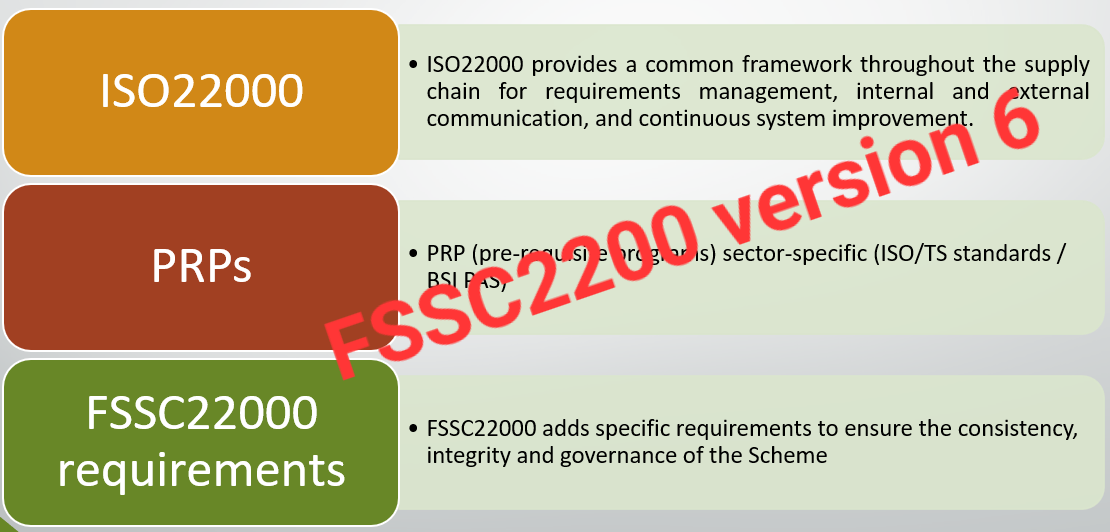
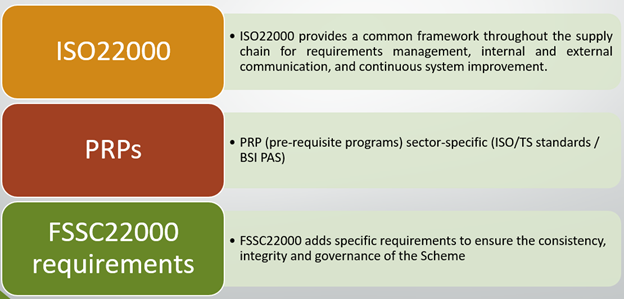
The FSSC scheme consists of 3 mandatory components:
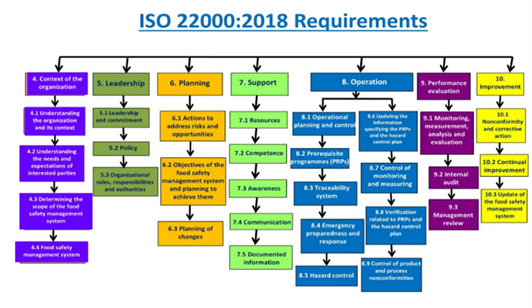
ISO22000:2018
The ISO22000 standard is the first food safety management system standard developed by the international organization for standardization – ISO (International Organization for Standardisation).
The ISO organization has over 20,000 published standards and annually engages in the development of over 1,000 new standards. Some of the most widely used ISO standards: ISO9001, ISO14000, ISO45000. They are harmonized with Annex SL – reason for changes in 2015 and 2018 (HLS-High level structure). ISO22000:2018 published in June 2018 – the first revision of this standard since its publication in 2005.
Basic principles incorporated in the food safety management system standard:
1. Process approach
2. PDCA cycle (2 PDCA cycles within ISO22000:2018)
3. Risk-based thinking (The basis for achieving an effective product safety management system is risk-based thinking).
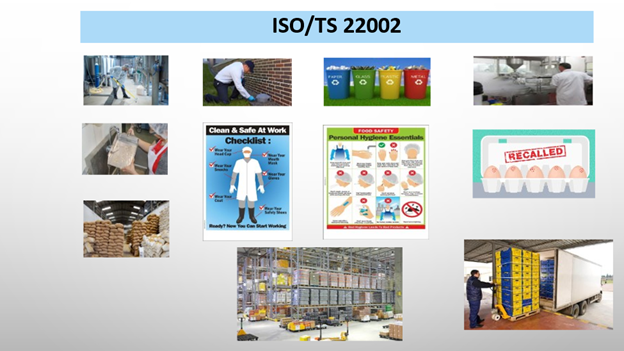
ISO/ TS 22002
The ISO/TS 22002-1:2009 standard specifies requirements for the establishment, implementation and maintenance of prerequisite programs (PRPs) to assist companies in controlling food safety hazards. Once the prerequisite programs are in place, food is less likely to be compromised. Clear requirements related to:
- Construction and arrangement of buildings (environment, location of the building)
- Arrangement of premises and work space (interior appearance, layout of roads and movements, internal structures and connecting elements, arrangement of equipment, laboratory spaces, temporary or mobile facilities and vending machines, storage of food, packaging materials and ingredients)
- Infrastructure-water, air, energy (water supply, boiler water treatment chemicals, air quality and ventilation, compressed air and other gases, lighting)
- Waste disposal
- Suitability of equipment, cleaning and maintenance (hygienic design, surfaces with which the product comes into contact, temperature control and monitoring equipment, cleaning of plants, tools and equipment, preventive and corrective maintenance)
- Management of input materials (selection and dealing with suppliers, requests for input materials)
- Measures to prevent cross-contamination (microbiological cross-contamination, allergen management, physical contamination)
- Cleaning and sanitation
- Removal of pests
- Premises for employees and personal hygiene (premises for personal hygiene and toilets, canteens and designated places for employees to eat, work and protective clothing, state of health, illnesses and injuries, personal hygiene, individual behavior)
- Rework
- Product recall procedures
- Storage
- Product information and consumer awareness
- Food protection, bioterrorism and sabotage
FSSC22000 – additional requirements
The third part refers to the additional requirements of the FSSC2200 scheme and these include:
- Management of services and purchased materials
- Marking of products
- Food defense
- Food fraud
- Allergen management
- Environmental monitoring
- Product development and additional requirements depending on the FSSC categories (FSSC categories follow the food categories described in the ISO/TS 22003 technical specification).
To familiarize yourself with the current version of the standard, you can attend our regular on-line training, where all the requirements of version 5.1 are explained in detail. FSSC2200 scheme !!!
For help in implementing the requirements of the FSSC2200 scheme, you can contact our Agency for help !!!