Select an image or table to view it at full size in a new tab.
It seems that food safety management standards place significant emphasis on allergens. However, if I present the following data, you may conclude that this topic is discussed far too little:
- The number of people allergic to food-related allergens has reached 220 million worldwide.
- Allergies manifest to over 170 types of food.
- Emergency medical interventions due to anaphylactic shock (a systemic allergic reaction that can be life-threatening) occur every 2-3 minutes.
We have addressed allergens in our previous articles:https://asconsulting.rs/allergens-differences-in-eu-us-legal-requirements/
What is an allergy?
An allergy is an immune system reaction where the body identifies an otherwise harmless substance as harmful. The immune system responds aggressively to protect the body, producing a large quantity of antibodies (IgE).
How does the body react to food allergens?
Foods or substances that trigger allergic reactions are called allergens. In most cases, allergens in food are proteins, and a single food item may contain one or more allergenic proteins.
Allergic reactions to food involve the rapid release of powerful cellular chemicals like histamine, which mast cells release when the body detects an allergen. These reactions often occur within minutes, though they can take up to two hours after ingestion.
Even small amounts of food containing allergens can trigger a reaction. Such reactions may range from mild/moderate symptoms to anaphylaxis, a potentially life-threatening condition. Notably, mild or moderate reactions can escalate quickly.
Recognizing an allergic reaction
Symptoms of food allergies vary in nature and severity between individuals. Signs of mild to moderate allergic reactions include:
- Swelling of the lips, face, or eyes
- Hives or welts
- Tingling in the mouth
- Stomach pain
- Vomiting

Traces of Allergens
Allergens can appear in food production in two main ways:
- Direct addition of allergenic material:
This occurs when allergenic material is an ingredient in the food product or part of the process at some stage. Key considerations for managing allergens in such cases include:- Ingredients (including sub-ingredients in complex components that may contain allergens)
- Additives (including solvents, media for additives, or cleaning agents)
- Processing aids
- Cross-contact with allergenic material:
This happens when the allergenic substance is not an intended part of the food product but unintentionally contacts it. This can occur through:- Ingredients carrying a known risk of cross-contact
- Rework materials incorporated into other products
- Residual material accumulating in processing equipment and contaminating subsequent products
- Environmental contamination during processing (e.g., powder clouds or aerosols contaminating adjacent lines)
- Contamination from storage, tools, clothing, or packaging
In such cases, we refer to trace allergens, which are crucial because unidentified allergens can pose severe risks to consumers, potentially leading to anaphylactic shock. Some may argue that trace amounts are insignificant—but this is far from true.
How Much Is Too Much?
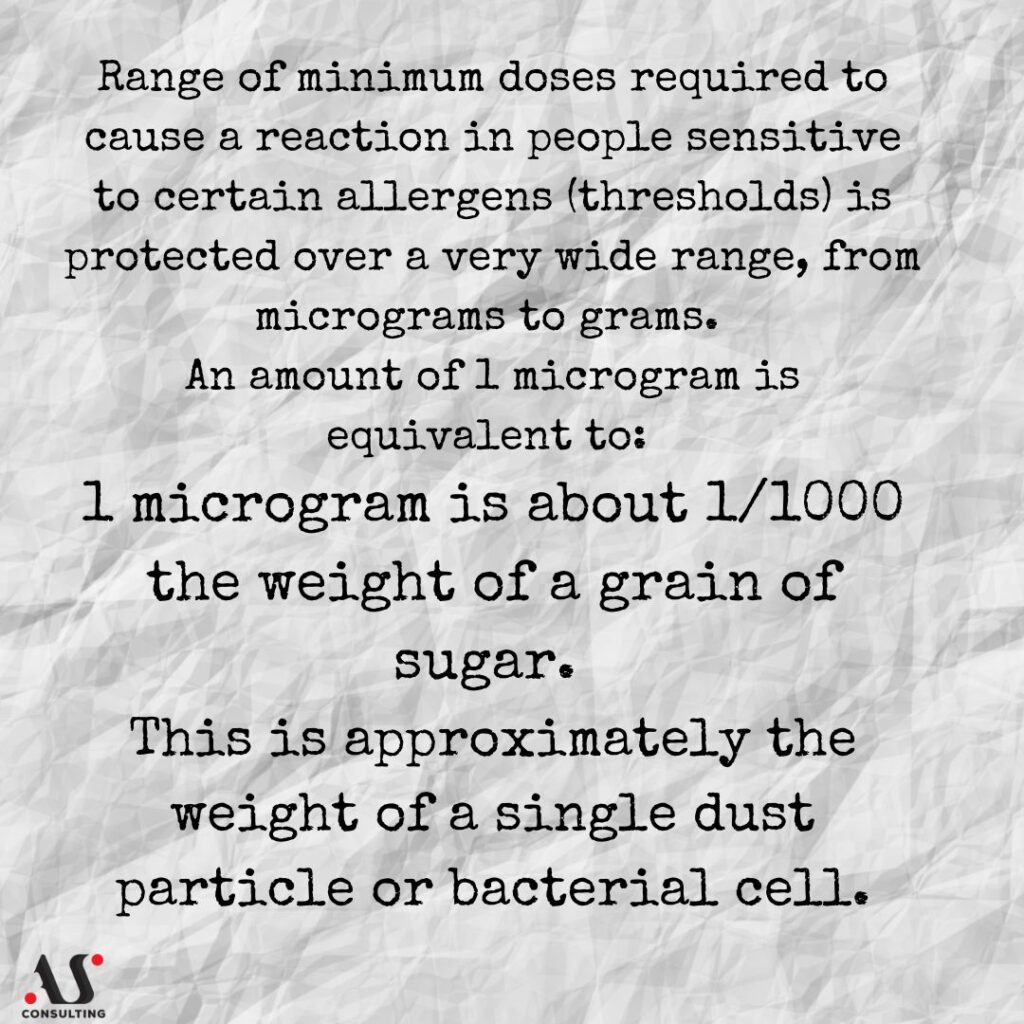
We are becoming increasingly sensitive not only to allergens but also to trace amounts. Studies show that the minimum doses required to trigger reactions in sensitive individuals vary widely, ranging from micrograms to grams.
For context:
- 1 microgram equals about 1/1000 the weight of a grain of sugar.
- It is roughly the weight of a single dust particle or bacterial cell.
Does this help illustrate how little can be too much for some individuals?
Ensuring Health and Safety in Food Production
Companies producing food products are obligated (per standards and regulations) to:
- Conduct hazard analyses for allergens.
- Implement preventive measures to mitigate cross-contamination.
- Declare allergens on product labels.
The critical question then becomes: At what trace levels should allergens or potential traces be declared?
According to “Quality Assurance and Food Safety: Science Update: Allergen Threshold Values” (Lisa Lupo, February 17, 2012):
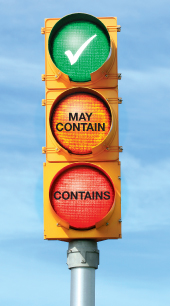
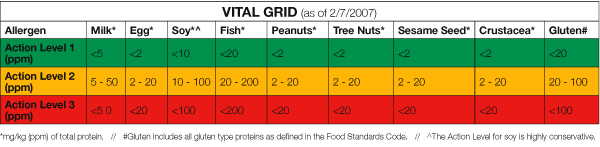
- Green zone: No precautionary statement is needed.
- Yellow zone: A statement like “may contain” is required.
- Red zone: Allergen labeling is mandatory.
Think about that!😊
To conduct a thorough allergen hazard analysis, sufficiently trained personnel are essential. If you require training or assistance with developing hazard analyses, feel free to contact our agency!