
CAUSES OF FOODBORNE DISEASES: PATHOGENIC MICROORGANISMS
January 18, 2026
FSSC22000 STANDARD: TOWARDS VERSION 7
March 20, 2026
The ISO 22002:2025 series was officially published in July 2025 by the ISO organization. The previous document that established the requirements for prerequisite programmes was the technical specification TS ISO 22002:2009. The main difference between these two documents is that in the technical specification everything was contained within a single document, whereas the 2025 revision introduces general requirements defined through ISO 22002‑100:2025 and explicit requirements through the sector-specific standards of the ISO 22002‑1 to 7:2025 series.
The key innovations are:
- In the 2025 version, requirements have been added or significantly expanded: Food defence, Food fraud, control of fraud in the supply chain, supply chain security, raw material and bulk material safety, waste and food loss management, and stronger allergen requirements.
- Improved alignment with ISO 22000:2018: The new version is more clearly linked with the HACCP and PRP logic from ISO 22000. The structure has been reorganized to be easier for auditing and gap analysis.
- Added sustainability elements: the new version introduces topics that were previously not explicit, such as efficient use of water and energy, waste management, reduction of food loss, and environmental impact of production.
- Clearer wording.

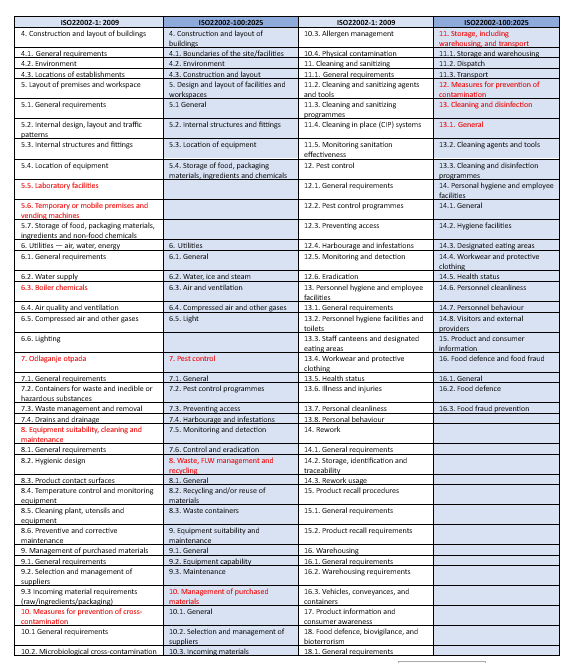
In this text, we will go through the innovations related to the general requirements defined through ISO 22002‑100:2025, comparing them with TS ISO 22002:2009.
MAIN DIFFERENCES BETWEEN TS ISO 22002:2009 AND ISO 22002‑100:2025
Chapter 4 provides more detailed requirements regarding facility construction and layout. It now starts with defining the site boundaries that must be maintained to ensure food safety, followed by the environment, where it more clearly explains which aspects require attention as potential hazards (e.g., contaminated areas and industrial activities that could reasonably contaminate products; flood-prone areas, etc.).
Chapter 5 in the new version presents clearer requirements for preventing cross-contamination in terms of layout. It offers options for time separation and zoning, which can significantly help achieve safe product requirements (hygiene zones (low / medium / high care), control of people, material, and waste movement, cross-contamination risk assessment, clearer rules for separating raw materials and finished products).
Chapter 6 introduces significant details that help better understand air-related requirements:
- air quality monitoring
- condensation management
- control of compressed air in contact with food
- validation of air filtration
Chapter 7 in the new version relates to pest management, whereas in the old version this was in Chapter 12. Innovations include trend analysis of infestations, risk assessment by zone, control of biological and physical barriers, and stronger control of the external environment. The focus is more on prevention rather than reaction.
Chapter 8, regarding waste management, is much more detailed than Chapter 7 in the old version (which dealt with waste management). Extensions also cover Food Loss and Waste – FLW, where:
- Food Loss: food lost before it becomes a finished product or before sale.
- Food Waste: food that has already been produced or prepared but is discarded.
A new requirement is the management of recyclable and/or reusable materials, which must be properly managed and tracked.
Chapter 9, related to equipment, provides a much more detailed description of equipment requirements, including risk assessment for contamination during maintenance, control of tools and spare parts, hygienic equipment design, and more detailed maintenance planning requirements.
Chapter 10, concerning the management of purchased materials, introduces a significant change: a risk-based approach. The process must be justified by a hazard assessment, including potential risks to the finished product. The organization must:
- conduct supplier risk assessments
- define criteria for supplier audits, certification, and raw material testing
Chapter 11, regarding transport and storage, is also clearer than the previous version, covering:
- temperature and humidity control and monitoring of storage conditions
- correct stacking of materials and prevention of damage
- requirements for special labeling, physical segregation, and access control for non-conforming products
- temperature control during transport (where temperature monitoring is required), protection from moisture and condensation
- vehicle inspection prior to loading (temperature, hygiene, etc.)
Chapter 12, on measures to prevent contamination, is general compared to the previous version (covering measures to prevent microbiological, physical contamination, and allergen management). The scope is general and states that measures must be in place to prevent cross-contamination, with details described in sector-specific standards.
Chapter 13 covers facility hygiene, emphasizing risk assessment. Cleaning and disinfection programs must align with food safety hazards associated with products and processes at the site.
Chapter 14, regarding personal hygiene rules, provides principle-based requirements (defined by the company based on risk assessment) aimed at preventing contamination, with details given in the sector-specific standard. Slightly more explicit requirements are included for visitors and external suppliers, who must be trained on internal requirements and comply with them before entering the organization.
Chapter 15 does not introduce major changes as it deals with principle-based requirements related to consumer information, enabling correct storage and use of the product.
Chapter 16 addresses food defence and food fraud requirements. This chapter can be considered entirely new. In the previous version, Chapter 18 touched on general food defence requirements, but here the requirements are explicitly defined, with the introduction of food fraud requirements.
SECTOR-SPECIFIC STANDARDS
In addition to ISO 22002‑100:2025, the benefits of the sector-specific standards include:
- ISO 22002‑1:2025 — Food manufacturing (PRP for food manufacturing; replaces ISO/TS 22002‑1:2009)
- ISO 22002‑2:2025 — Catering (PRP for catering services; replaces ISO/TS 22002‑2:2013)
- ISO 22002‑4:2025 — Food packaging manufacturing (PRP for food-contact packaging; replaces ISO/TS 22002‑4:2013)
- ISO 22002‑5:2025 — Transport and storage (PRP for supply chain transport and storage; replaces ISO/TS 22002‑5:2019)
- ISO 22002‑6:2025 — Feed and animal food production (PRP for animal feed production; replaces ISO/TS 22002‑6:2016)
- ISO 22002‑7:2025 — Retail and wholesale (PRP for retail and wholesale; new inclusion in the series, previously covered by PAS 221:2013)
In short, the ISO 22002 series now has one general standard (Part 100) plus six sector-specific parts (Part 1, Part 2, Part 4‑7) covering the main sectors in the food safety chain — from manufacturing through catering, packaging, logistics, animal feed, to retail — providing a significantly more comprehensive understanding of PRP requirements.