

Select an image or table to view it at full size in a new tab.
Quality management and product safety standards, recognized by GFSI (such as IFS, BRC, FSSC22000), cover the entire supply chain, starting from production, logistics, to agents and brokers, as well as wholesale and Cash & Carry chains. In this text, we will present the latest version of the IFS Wholesale / Cash & Carry standard – version 3.
The IFS Wholesale / Cash & Carry standard applies to wholesalers, Cash & Carry companies, and companies involved in the packaging of eggs, fruits, and vegetables. It concerns wholesalers and Cash & Carry companies engaged in wholesale activities related to food, household products, personal care products, and/or packaging.
Such activities may include procurement, product development, storage, transport, and/or certain processing and/or handling activities.
Origin of the standard and valid version
The IFS Wholesale / Cash & Carry standard was developed in 2010 by IFS Management GmbH, with the aim of preserving product quality and safety in sales chains, as well as establishing an equal system of control and management of safety and quality from production to delivery of food products to consumers.
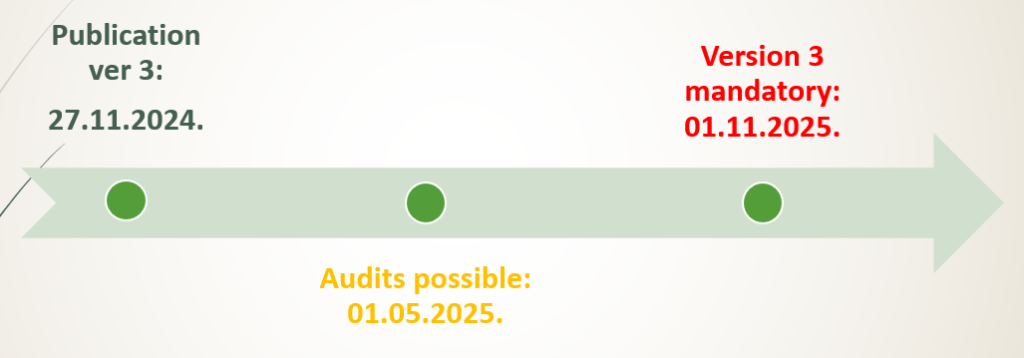
The latest version of this standard is version 3, which was published on November 27, 2024. The transition period is such that audits under version 3 can start from May 1, 2025, and mandatory implementation begins on November 1, 2025.
Most significant changes in version 3
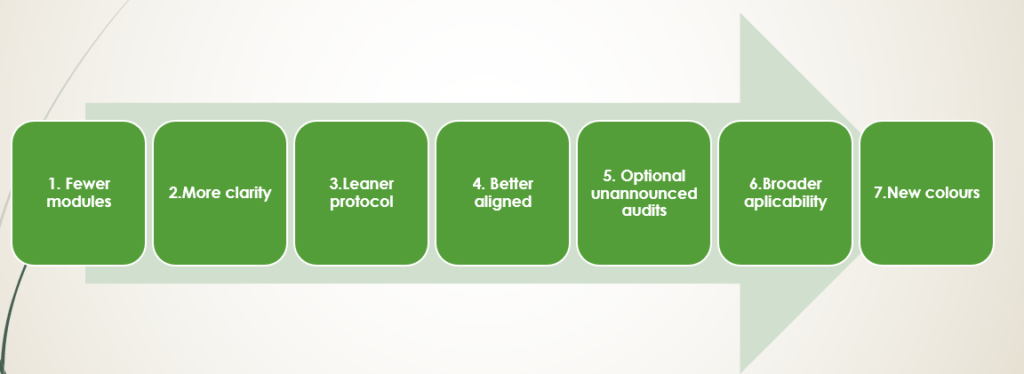
The most significant changes in version 3 are:
- Fewer modules: the number of modules has been reduced from four to two, and the same checklist applies for both wholesalers and Cash & Carry chains;
- More clarity: updated definitions of technological scopes;
- Leaner protocol: fewer requirements in the standard, and the protocol checks have been simplified;
- Better alignment: the structure, scoring system, and terminology have been aligned with other IFS standards, especially IFS Food and IFS Logistics;
- Optional unannounced audits: companies can voluntarily choose the option of an unannounced audit, and in such a case, a star is added to the certificate;
- Broader applicability: the standard is applicable to food delivery services as well;
- New colours: the logo in version 3 has new colors.
Types of audits and evaluation methods
The types of audits are identical to those of other IFS standards:
- There is an initial and recertification audit, as well as the option of an extension audit and a follow-up audit (in case of a Major score in the main audit);
- Both announced and unannounced options are available, with the difference being that in this scheme, unannounced options are exclusively voluntary;
The evaluation method is the same as in other IFS schemes: - Deviations can be scored as A, B, C, or D;
- Non-conformities: KO (knockout) and Major non-conformities.
KO requirements in the IFS Wholesale / Cash & Carry standard:
1.2.2 Management and commitment
2.2.1.1 Product safety management system
2.3.9.1 Tracking system for each CCP
4.11.1 Reducing the risk of foreign materials
4.17.1 Traceability
5.1.1 Internal audits
5.9.1 Product withdrawal and recall procedures
5.11.3 Corrective actions

Standard structure
The structure follows that of other IFS standards:
- Management and commitment
- Quality and product safety management system
- Resource management
- Core processes
- Measurements, analysis, improvements
What distinguishes this standard from the others is the “classic” and “plus” requirements. Namely, in cases where there is no food processing (e.g., packaging and processing of meat or fish), only the basic requirements are applied, while in cases of food treatment/processing, the “plus” requirements are also applied.
In Annex 4 of the standard, it is clearly explained which types of food treatment/processing the requirements can apply to (e.g., Block freezing (minimum -18 °C / 0 °F), including storage, quick freezing, cooling, cooling processes, and appropriate storage in cooling, defrosting; sorting, washing, cleaning, packaging, labeling, etc.).
Implementing the IFS Wholesale / Cash & Carry standard is an excellent opportunity to improve the operations of your wholesale businesses, so: contact us to help you with this!!!