
Select an image or table to view it at full size in a new tab.
(On examples of food standards : IFS, BRC, FSSC22000)
We are witnessing that big changes are happening in the market when we talk about the production of food products. Just a decade ago, the market in our region looked completely different. Branded products were preferred, while private brands were only slowly making their way as a new offer to customers. However, with the arrival and expansion of large food chains (retailers), the situation has changed significantly. Today, there are few manufacturers of food products who managed to “defend” themselves from production for some of the many PL brands. This brings with it numerous benefits for manufacturers, but also places serious demands on them regarding product quality and safety.
Therefore, read the following text carefully, because in it you will find many valuable tips for successfully maintaining a food safety management system, gathered through extensive experience in various types of food operations.

What is the PL brand?
In response to the growing crisis and the reduction of consumer purchasing power, retail chains offer customers products under their own (private) brand – PL, which are 10-35% cheaper than “branded” products. And while these products used to be of lower quality than branded products, with a small market share, today they are of the same quality and taste, but at significantly lower prices than branded products, and as such they are attracting increasing interest from consumers. That is why today the situation is such that there is almost no food product that has not received a replacement in the form of a product under a private brand in one of the large retail chains.
Since private labels are owned and branded by large retail chains, they guarantee their quality and are responsible for any non-conformities. Therefore, in order to gain and maintain the trust of customers, they choose manufacturers who will be able to meet the appropriate standards of product quality and health safety (when it comes to food products). In order for a certain manufacturer to start cooperation with a large trade chain and related to production under the name of a private brand, he must meet the requirements related to the standards of that trade chain and often also introduce the quality or health safety standard of the product that that trade chain requires.
You can find about the advantages and disadvantages of working for PL brands in our text:
What do you have to fulfill to be a PL brand manufacturer?
The requirement that is placed before your company and before you enter the selection for the manufacturer of the PL brand is that you have implemented (and are implementing the requirements) some of the GFSI recognized standards!
You can get to know the GFSI recognized standards and their requirements in detail in our text:
- So, the first thing you have to fulfill is that you are certified by some of the GFSI recognized standards (IFS, BRC, FSSC22000…).
Well that sounds simple 😊
A large number of companies are certified today 😊
But they all claim that they did not get there easily and that it is difficult to maintain the system at the higher level required by the contract ☹
We do not claim that implementation is easy, but with serious work and dedication, success is guaranteed! We understand your concern, that’s why we will share with you practical tips that will help you to make the implementation and/or maintenance of the system fun and inspiring and not tiring and scary.
How to successfully pass a GFSI audit?
1.Of course, the first thing you should do is familiarize yourself with the requirements of the standard that will be (or has already been) implemented in your company. The requirements of each of the GFSI standards are written very clearly and precisely, so that if you already have experience, you can implement additional requirements yourself.
2.The part related to the documentation sounds easy and interesting, all you need is to clearly follow each of the requirements of the standard: the advice is to read the requirement carefully and to use the glossary for certain terms, which is an integral part of every standard: this is especially important in order to understand what is required (what is “must or shall”) and what is a recommendation (what is “may or should”);
3.The most important part (which is often eliminative) is the infrastructure requirements. It is clear that sometimes it is a challenge to eliminate all defects in a short period of time… and there is no time… What to do in that case? The advice is to focus on potential CRITICAL, MAJOR, Knock out non-conformances as this is what can lead to elimination and MINOR and deviations can be resolved after them. How to recognize what is “urgent” and what is “less urgent”. I suggest that we first start with the definition of non-conformity and deviations. Different standards call them differently, but the essence is the same:
- CRITICAL (BRC food): Where there is a critical failure to comply with a food safety or legal issue.
- Knock out (IFS Food): If grade D (requirement not implemented) is achieved on any of the 10 KO requirements, 50% of possible points are lost and it is not possible to pass the audit at all;
- Major (BRC food): Where there is a substantial failure to meet the requirements of a ‘statement of intent’ or any clause of the Standard, or a situation is identified which would, on the basis of available objective evidence, raise significant doubt as to the conformity of the product being supplied.
- Major (IFS food): can be issued on any regular request (not defined as a KO request). The reasons for the major grade are:
• There is a significant failure to meet the requirements of the standard, which includes but is not limited to food safety and/or legal requirements of the countries of production and/or destination.
• The process is out of control which can affect food safety. A major grade entails the deduction of 15% of the total score and the certificate cannot be issued without a “follow up” audit;
- Minor (Brc food): Where a clause has not been fully met but, on the basis of objective evidence, the conformity of the product is not in doubt.
- Deviation: A, B, C, D (IFS food): deviations carry a certain percentage of points, but they are not eliminative and the conformity of the product is not disputed.
How to distinguish Minor from Major or Critical, or deviation from non-conformity, we will show with an example:
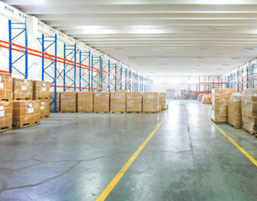
- Minor floor damage in the warehouse of finished products: the products are closed and protected from external influences (closed products area): MINOR (BRC) or Deviation (IFS):
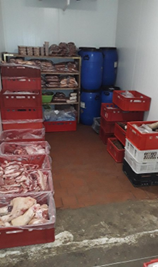
- Smaller floor damage in open product area: Major (IFS) or Critical (BRC):
Implementation and/or maintenance of standard requirements is certainly easier with professional support, so we invite you to contact us and clarify your doubts so that together we can find the right package of services for you!!!!