
FSSC22000 STANDARD: TOWARDS VERSION 7
March 20, 2026
The Global Food Safety Initiative (GFSI) has released an updated version of its Food Safety Culture Requirements document, “Food Safety Culture” (Version 2.0, March 2026). This document represents a significant step forward in harmonizing the way organizations define, assess, and strengthen food safety culture worldwide. The updated document integrates insights from more than 180 academic and industry sources, including empirical studies, behavioral sciences, organizational research, and professional guidelines.
As a reminder, the GFSI (Global Food Safety Initiative) is an initiative for the continuous improvement of food safety management systems to ensure the delivery of safe food throughout the supply chain. GFSI recognizes food safety management system schemes that meet the criteria of the GFSI Guidance Document.
So, can we expect changes in food safety standards? Let’s recall the requirements related to food safety culture that we have already written about:
What does the new GFSI “A Culture of Food Safety – Position Paper ver. 2.0” bring?
1. Updated definition of food safety culture
Until now, we have learned that food safety culture according to GFSI represents:
“Shared values, beliefs, and norms that influence mindset and behavior toward food safety throughout the organization.”
GFSI 2026 defines food safety culture as:
“a concept based on deeply rooted beliefs, behaviors, values, and assumptions shared by employees, which directly influence food safety performance.”
This updated definition reflects a more realistic view – culture is learned over time, embedded in people, and difficult to change without structured effort.
2. Two-layer food safety system framework (Wheel Model)
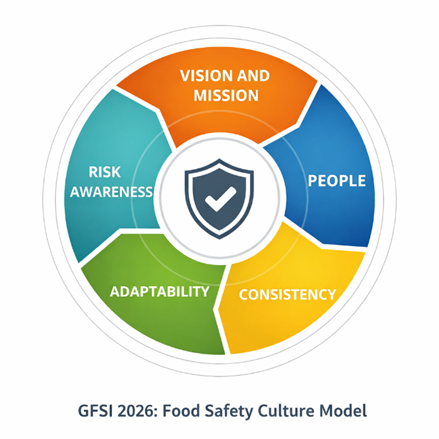
One of the most important innovations is the introduction of the “wheel model,” where food safety culture is viewed as interconnected dimensions rather than isolated elements.
The framework establishes a two-layer approach to food safety, identifying “Organizational Culture Foundations” and “Manifested Cultural Essentials.”
Level 1: Organizational Culture Foundations
These are the “building blocks” that shape culture within the organization:
- Company values, vision, and mission: Establish the organization’s purpose, ethical direction, and leadership expectations.
- People: commitment, empowerment, and accountability: Focus on workforce capability, process ownership, and engagement in food safety.
Level 2: Manifested Cultural Essentials for Food Safety
These essentials reflect how culture is practiced on a daily basis:
- Hazard and risk awareness: Employees’ ability to identify and respond to food safety risks.
- Consistency for food safety: Reliable implementation of the Food Safety Management System (FSMS), including HACCP and prerequisite programs.
- Adaptability, change, and continuous improvement: The organization’s ability to learn, respond, and evolve over time.
Culture and the system must work together
A key message from the updated guidelines is the integration of culture with the food safety system. Food safety is not driven solely by procedures, nor solely by culture, but by the interaction between formal systems (FSMS) and human behavior. High-performing organizations demonstrate alignment between what is documented and what is implemented in practice.
Critical components of food safety culture (8 pillars)
The guidelines further break down each dimension into critical components, providing greater clarity for assessment and improvement:
- Leadership and role modeling: Active involvement of management in promoting food safety.
- Communication: Two-way and transparent communication on food safety issues.
- Accountability and ownership: Clearly defined roles and responsibilities for food safety.
- Training and knowledge transfer: Continuous education and skills development of employees.
- Behavior and attitude: Encouraging a positive attitude toward food safety.
- · Teamwork and collaboration: Cooperation across departments and levels to achieve food safety goals.
- · Work pressure and operational reality: Managing pressures that may impact food safety.
- · Recognition and empowerment: Acknowledging and rewarding contributions to food safety, as well as empowering employees to take initiative.
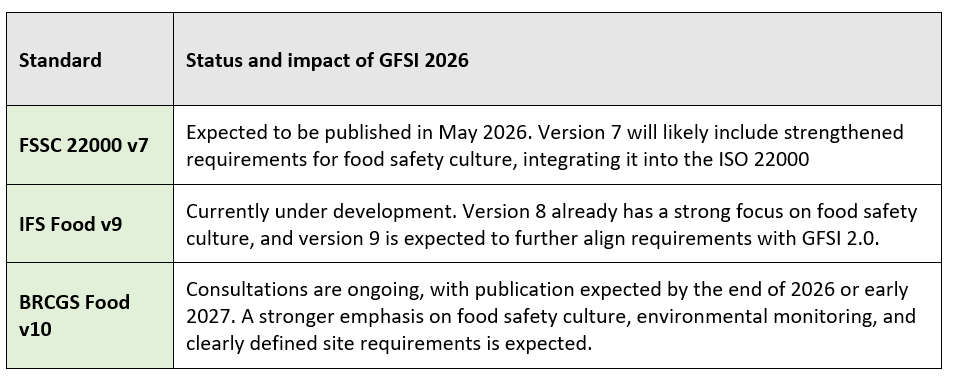
Impact on Food Safety Standards (2026)
The GFSI 2026 guidelines have a significant impact on GFSI-recognized food safety standards. These standards are expected to adapt to the new framework, with a particular emphasis on measurability and actionability of food safety culture.
What does all this mean for a company?
For companies in 2026, these changes represent a shift from “paper compliance” to demonstrable behavior. It is no longer sufficient to have a signed policy on the wall; auditors now require evidence that every employee understands their role in preventing incidents.
Documentation covering the new requirements
Here is the specific documentation that addresses the new requirements:
- Food safety culture action plan
- Evidence of measurement and evaluation
- Communication and feedback
- Specific training requirements
- Improvement measures
If you require training related to food safety culture or need assistance in developing the necessary documentation and records, you may consult our agency.