
FOODBORNE ILLNESS
January 9, 2026
STANDARD ISO 22002:2025 – PREREQUISITE PROGRAMMES FOR FOOD SAFETY
March 7, 2026
Considering that nowadays food is generally assumed to be safe for consumption and that most of our attention is focused on its quality, have you ever wondered how many people fall ill each year as a result of consuming unsafe food?
Believe it or not, the numbers are devastating, according to data from the WHO (World Health Organization):
• Approximately 600 million people worldwide fall ill from foodborne diseases every year — that is almost 1 in 10 people on the planet.
• Around 420,000 people die each year as a result of foodborne diseases.
• In the European Region (53 countries), it is estimated that more than 23 million people fall ill annually due to diseases caused by contaminated/unsafe food, and around 4,700 people die each year directly as a result of these diseases.
The largest proportion of these diseases is caused by pathogenic microorganisms.
(source: www.who.int).
PATHOGENIC MICROORGANISMS
Pathogenic microorganisms are microorganisms that can cause disease in humans. In the context of food safety, they are most commonly divided into several main groups:
– Bacteria (the most common include: Salmonella spp., Listeria monocytogenes, Escherichia coli (pathogenic strains – e.g. STEC / EHEC), Campylobacter jejuni / coli, Staphylococcus aureus (toxigenic strains), Clostridium botulinum, Clostridium perfringens, Bacillus cereus, Shigella spp., Yersinia enterocolitica);
– Viruses (Norovirus (the most common cause of food-associated gastroenteritis), Hepatitis A virus, Hepatitis E virus, Rotavirus);
– Parasites (Toxoplasma gondii, Trichinella spiralis, Taenia spp. (tapeworms), Giardia duodenalis, Cryptosporidium spp., Anisakis spp.);
– Fungi: molds and yeasts: Molds themselves generally do not cause acute infections, but they produce mycotoxins (e.g. aflatoxin, ochratoxin A, patulin) that are toxic and carcinogenic.
The most common cause of diseases caused by unsafe food is pathogenic bacteria, therefore this text provides an overview of the most common disease-causing agents, as well as the conditions for their growth and development. Subsequent texts will present overviews of other pathogenic microorganisms.
PATHOGENIC BACTERIA AND CONDITIONS FOR THEIR GROWTH AND DEVELOPMENT
Below is an overview of pathogenic bacteria, the most common causes of foodborne diseases, as well as the conditions for their growth and development, the foods in which they are most commonly found, and preventive measures to avoid infection.
Before this overview, it is important to note that not every quantity of pathogens will cause disease; here we refer to the infectious dose, i.e. the amount of the agent that must be consumed for symptoms of foodborne disease to occur.
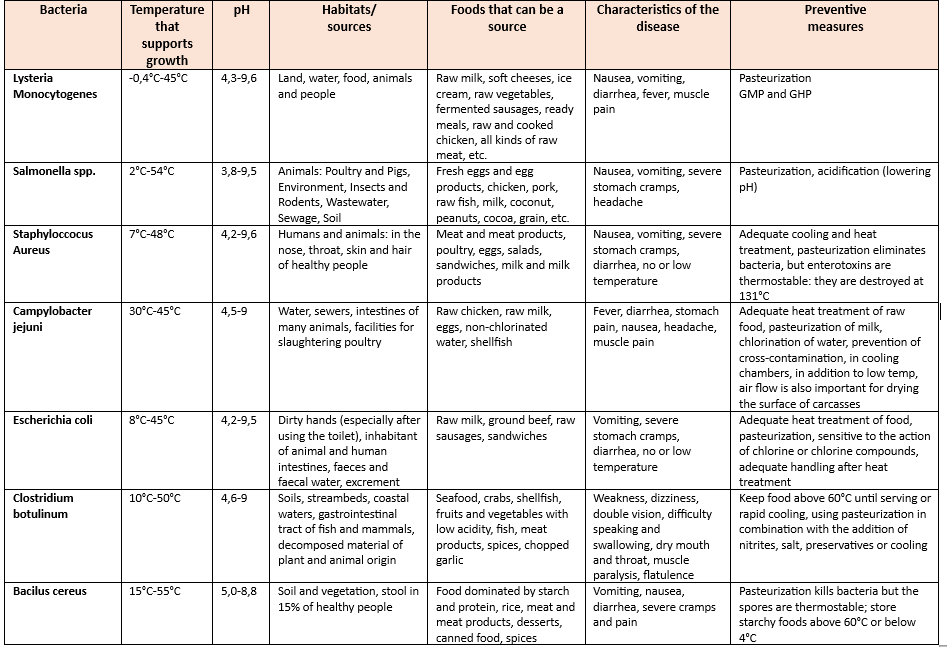
Infections caused by pathogenic bacteria can be prevented by increased hygiene levels, hygienic production, thermal processing and preparation of food, or treated with antibiotics. In order to prevent rather than treat, all protective measures at the food producer level are necessary, which is achieved through the implementation of food safety standards.
If you need assistance with the implementation of any food safety standards or improvement of the current food safety management system, contact our Agency!!!!