
MOSH and MOAH in food: what are they, where do they come from, and what does EU regulation say?
May 31, 2026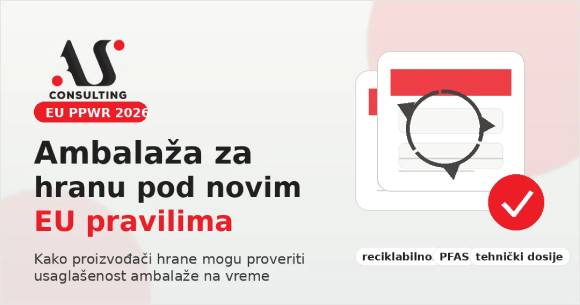
Packaging is no longer just a matter of marketing and logistics
For food manufacturers packaging has long been a combination of product protection, shelf life, design, sales appeal and logistical efficiency. However, with the new European Packaging and Packaging Waste Regulation, known as EU PPWR, packaging is also becoming one of the key regulatory compliance issues. PPWR entered into force on 11 February 2025, and general application begins on 12 August 2026.
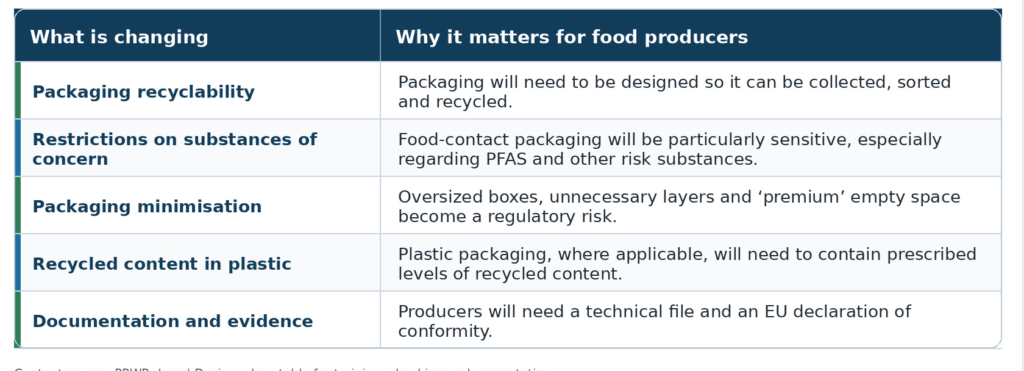
This change is particularly important for food manufacturers, because food packaging sits at the intersection of several sensitive areas: food safety, food contact, sustainability, recyclability, labeling and consumer expectations. In other words, the question is no longer only whether the packaging looks good and protects the product, but whether it can be demonstrated to meet the requirements of the EU market.
Key message for food manufacturers: PPWR should not be viewed as just another administrative requirement, but as a signal that packaging will become subject to much more detailed technical, environmental and market control.
What is EU PPWR and why it is important for food
EU PPWR, i.e. Regulation (EU) 2025/40, applies to all packaging and packaging waste, regardless of material, origin or sector of application. This means it covers plastic containers, PET bottles, multilayer films, cardboard boxes, glass jars, metal cans, closures, labels, transport boxes and e-commerce packaging.
For the food industry this is particularly significant because packaging must simultaneously meet two groups of expectations.
- First, it must protect the product, prevent contamination and enable a stable shelf life.
- Second, it must be designed to fit into European goals for waste reduction, recycling, reuse and reduction of primary raw material use. The European Commission states that one of PPWR’s objectives is for all packaging on the EU market to be recyclable in an economically viable way by 2030.
The biggest challenge: food packaging must be both safe and sustainable
For food, packaging decisions can never be made based solely on sustainability. Packaging must provide protection from moisture, oxygen, light, microbiological contamination, migration of unwanted substances and mechanical damage. That is why food manufacturers often use multilayer materials, barrier coatings, special closures and combinations of plastic, paper, aluminum or other materials.
This is where the challenge arises. A material that is excellent for extending shelf life may not be easy to recycle. A label that looks good can hinder sorting. Black plastic, metallized films, complex laminates, strong adhesives or inseparable layers can reduce packaging recyclability. PPWR therefore forces food manufacturers to think about packaging much earlier, already in the product development phase, and not only when the design has been approved.
PFAS and substances of concern: why this is especially sensitive for food
One of the topics that will attract the attention of the market and control authorities is the presence of substances of concern in packaging. PPWR provides for requirements to reduce the presence of such substances, and the European Commission particularly highlights restrictions for PFAS in packaging that comes into contact with food.
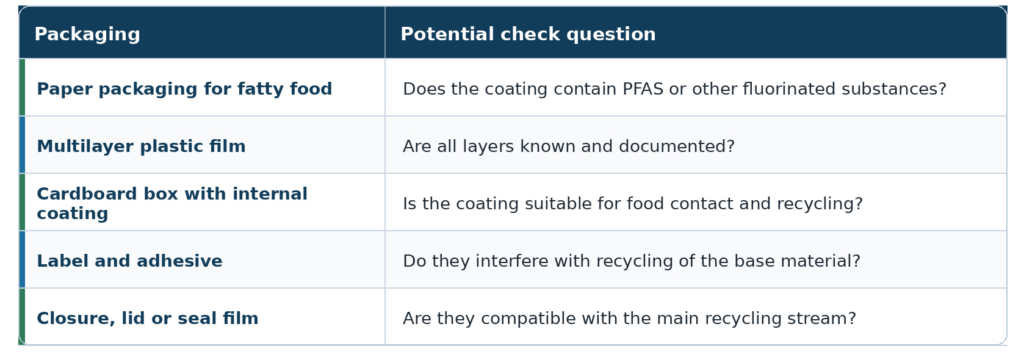
For food manufacturers this means that it will no longer be sufficient to have a general supplier statement that the material is “suitable for food”. It will be necessary to understand what the packaging is made of, which coatings and additives are used, whether there is a migration risk and whether the supplier can provide concrete evidence. This is especially important for paper and cardboard packaging with barrier coatings, packaging for fatty foods, fast food, bakery products, frozen foods and ready meals.
Recyclability: “can be recycled” will no longer be sufficient
Many companies today use claims on packaging such as “recyclable”, “eco-friendly” or “100% sustainable”. However, PPWR shifts the focus from a marketing claim to a demonstrable technical fact. Packaging will have to be designed for material recycling, and later to be recyclable in practice, i.e. realistically capable of being collected, sorted and recycled in existing or developed systems.
For the food manufacturer this means checking whether the packaging fits into the recycling stream to which it nominally belongs. A PET bottle with an inappropriate shrink label, a paper box with a plastic coating, a multilayer snack pouch or a combination of materials that cannot be easily separated may look acceptable from a functionality point of view, but be problematic from the PPWR perspective.
Minimization of packaging: the end of unjustified “empty space”
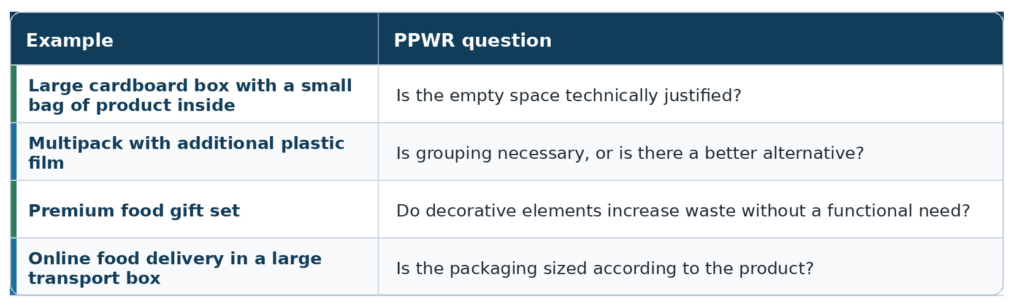
PPWR also introduces a stricter approach to packaging minimization. Packaging should be designed so that mass and volume are limited to the minimum necessary for functionality, safety, hygiene and product acceptability. However, additional packaging that exists only for marketing, perception of a larger product or a luxurious appearance becomes increasingly difficult to justify.
This can have direct consequences for food products that use large boxes with a small content, multiple wraps, decorative sleeve elements, unnecessary trays or packaging with large empty space. Special attention should be paid to multipack packaging, promotional packaging, confectionery products, premium products, gift packaging and e-commerce food deliveries.
What you should do right now
The biggest mistake would be to wait for all details to be further clarified through secondary legislation, standards and national procedures. Although certain technical details of PPWR will continue to be developed, the basic direction is already clear: packaging must be easier to recycle, better documented, less wasteful and safer with regard to substances of concern.
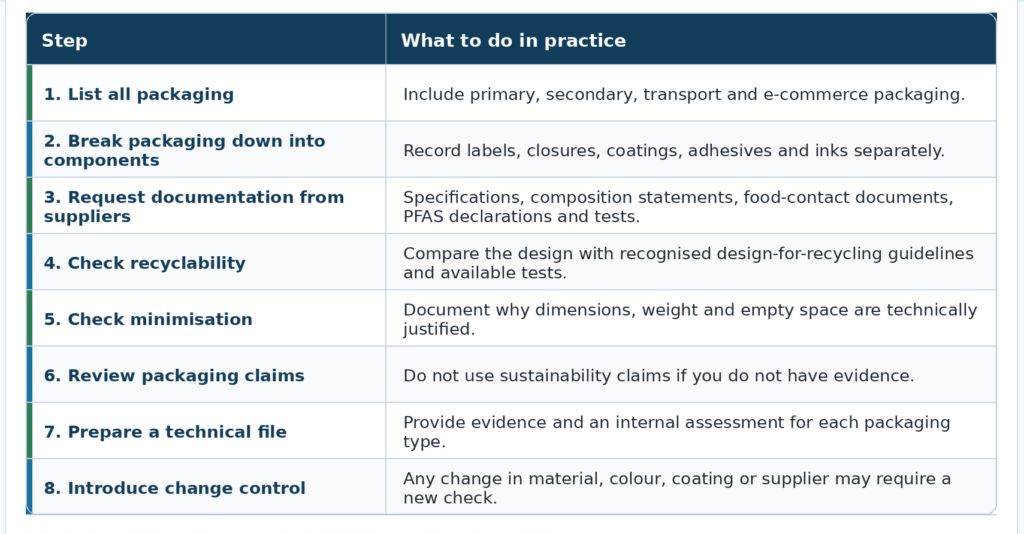
For food manufacturers the best first step is to create an internal packaging register. That register should list all packaging formats, materials, suppliers, markets, purpose, food contact, claims on the packaging and available documentation. Only when you know what you use can you assess where the greatest risks are.
Technical dossier: the document that will make the difference
PPWR provides that the manufacturer, through the internal production control procedure, prepares technical documentation and issues an EU declaration of conformity for the relevant type of packaging. In practice, the technical dossier will become the central document by which you demonstrate that you checked the packaging before placing it on the market.
For a food company that dossier should not be just a formal folder. It should link product development, procurement, quality, regulatory affairs, marketing and sustainability. If marketing wants a new label, procurement a new film supplier, and product development a longer shelf life, someone must check whether those changes affect PPWR compliance.
If you produce food, start from three questions: what exactly is my packaging made of, can I prove its safety and recyclability, and do I have documentation that confirms this. If the answer to any of these three questions is not clear, the PPWR check should start immediately!!!!!
For any uncertainties our Agency offers assistance!!!