
TACCP vs VACCP: What is the difference and how to prevent food fraud?
May 17, 2026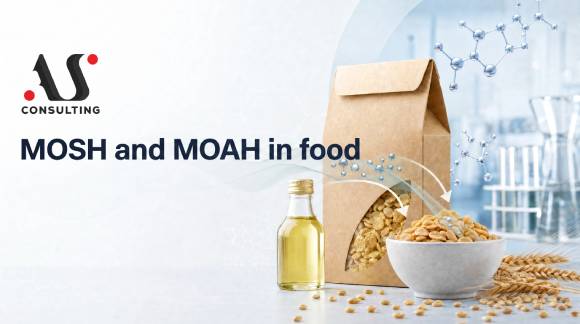
MOSH and MOAH are fractions of mineral oil hydrocarbons that may enter food from packaging, lubricants, additives, processing equipment, and the environment. In the EU, the regulatory focus is particularly on MOAH because of the possible genotoxic and carcinogenic potential of certain aromatic fractions.
In the last few years, MOSH and MOAH have been mentioned increasingly often in food safety control, especially when discussing contaminants that may come from the production process, transport, packaging, or raw materials.
MOSH and MOAH are the two main groups within mineral oil hydrocarbons, i.e. MOH (mineral oil hydrocarbons). According to the European Commission, MOH are a diverse group of chemical compounds that originate primarily from crude oil, but they may also be produced from coal, natural gas, or biomass. They are significant in food because they may occur as unintended contaminants, but also because their origin is not always easy to determine.
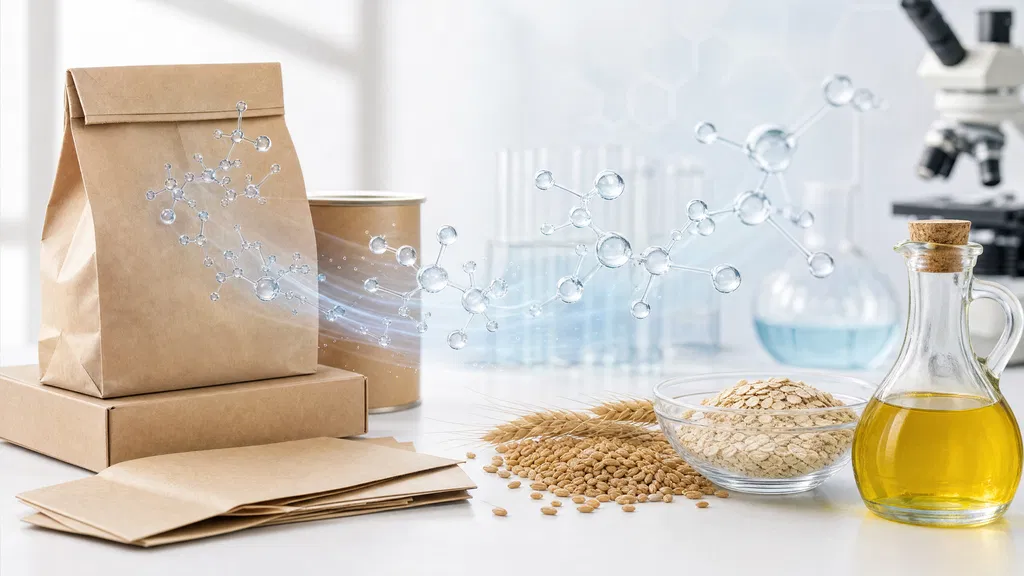
What are MOSH, and what are MOAH?
MOSH stands for mineral oil saturated hydrocarbons, i.e. saturated hydrocarbons of mineral oil. MOAH stands for mineral oil aromatic hydrocarbons, i.e. aromatic hydrocarbons of mineral oil. These two fractions differ in chemical structure, but also in toxicological significance.
Where can MOSH and MOAH enter food from?
Contamination of food with mineral oil hydrocarbons may occur at different stages of the supply chain. Therefore, in practice, it is often not possible to conclude from a single analysis result that the source is exclusively packaging, raw material, or the process. An investigation is required that covers raw materials, production, transport, storage, packaging, and storage conditions.
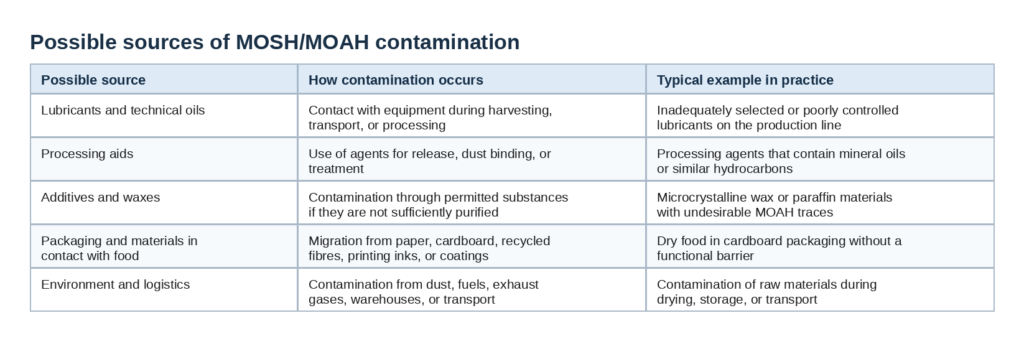
Commission Recommendation (EU) 2017/84 particularly emphasises that migration from materials in contact with food, including paper and cardboard packaging, may significantly contribute to overall exposure and that monitoring should cover both food and packaging material when such a source is suspected.
Why are MOAH particularly problematic?
For MOAH, the key problem is that this fraction is not a single substance, but a complex mixture. Within that mixture there may be aromatic compounds of different structures and different toxicological profiles.
For the food industry, this means that a finding of MOAH should not be treated only as a laboratory non-compliance, but as a signal to determine the source of contamination and introduce corrective measures.
EU regulatory framework: what currently applies?
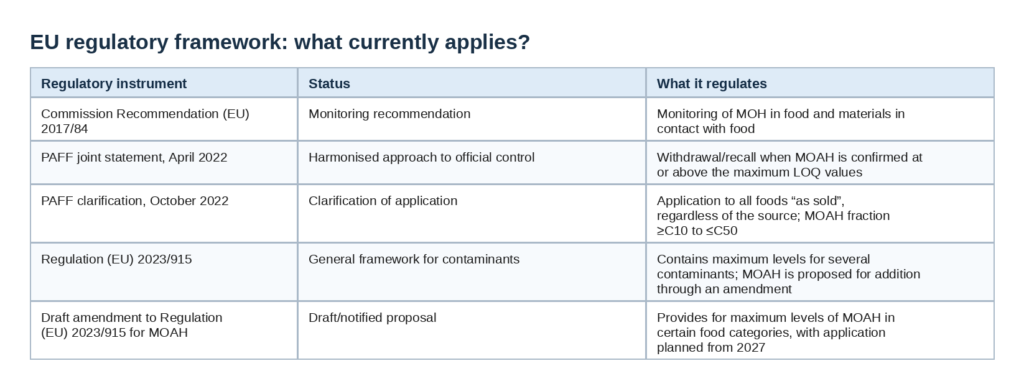
It is important to emphasise the following: in the EU, the regulatory focus relates primarily to MOAH, while general maximum levels for MOSH have not been established in the same way. For MOSH, the emphasis is on monitoring, understanding sources, and minimisation measures, while stricter risk management mechanisms are being introduced for MOAH because of toxicological concern.
What are the limits for MOAH?
In practice, the question is often asked: “What are the EU limits for MOSH and MOAH?” The answer must be precise. For MOAH, EU Member States agreed in 2022 on maximum LOQ values that are used for harmonised action in official control. These values are not the same as final maximum levels in an adopted regulation, but they are very important because they have been used as operational thresholds for product withdrawal or recall.
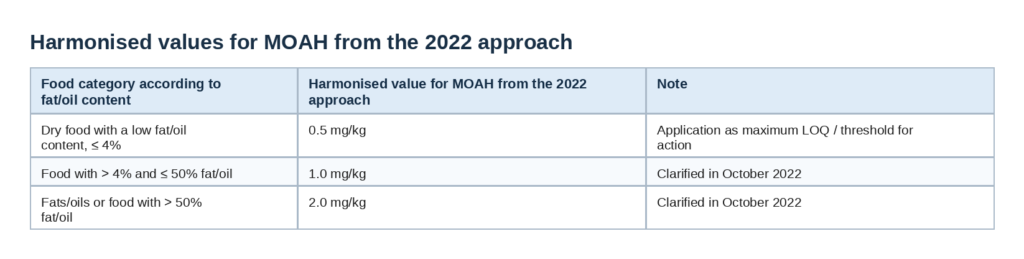
The latest EU draft provides for the introduction of a special section for MOAH (≥C10 to ≤C50) in Annex I to Regulation (EU) 2023/915. According to the available draft Rev.7 and sources from 2026, the application of maximum levels is planned from 1 January 2027, while transitional periods and gradual lowering of levels are provided for certain categories.
What does this mean for food and packaging producers?
For food producers, a finding of MOSH/MOAH requires a systematic approach. It is not enough to check only the final product. It is necessary to map possible sources: raw materials, processing agents, lubricants, additives, auxiliary materials, packaging, recycled paper and cardboard, printing, transport, and storage. It is particularly important to check whether the packaging is designed with an appropriate functional barrier, especially for dry food that remains in contact with paper or cardboard packaging for a long time.
For packaging producers, the topic is equally important because migration from materials in contact with food is explicitly cited as one of the possible sources of MOH contamination. This is particularly relevant for recycled fibres, printing inks, mineral oils from the printing process, and materials that do not have an adequate barrier towards food.
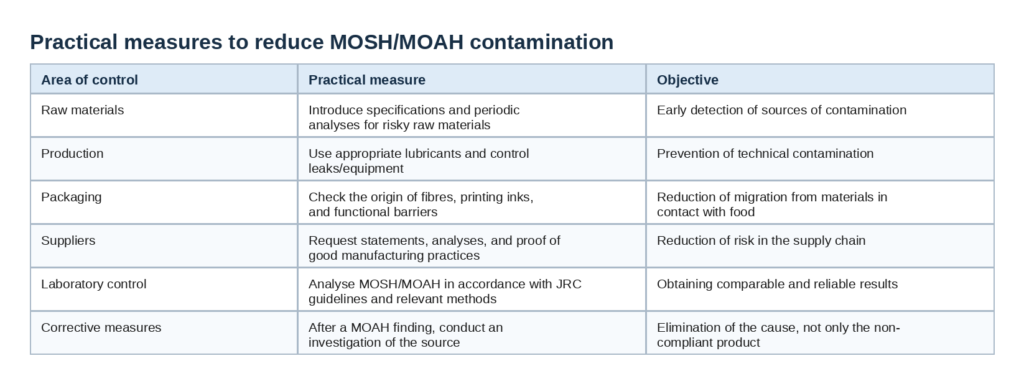
Practical measures to reduce MOSH/MOAH contamination
Management of MOSH/MOAH risk should be part of a broader food safety system, not a one-off analysis. Good practice involves a combination of laboratory monitoring, supplier assessment, and technological risk reduction measures.