
What Changes in Food Labelling from 1 July 2026?
April 24, 2026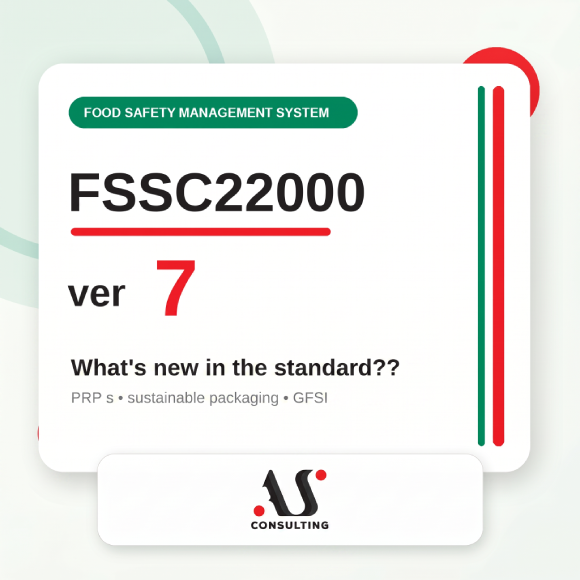
FSSC 22000 Version 7 was officially published on 1 May 2026 and represents an important upgrade to one of the most recognized certification systems for food safety.
The most important message for organizations that are already certified is that Version 7 is not merely an administrative refresh of documentation. It introduces significant changes in the areas of prerequisite programs, sustainability, packaging design, the structure of categories, and the management of new technologies. For this reason, the transition to V7 is an opportunity to view the food safety system not only as a certification requirement, but also as a tool for strengthening process control, reducing risks, and increasing customer confidence.
Why Was the New Version Published?
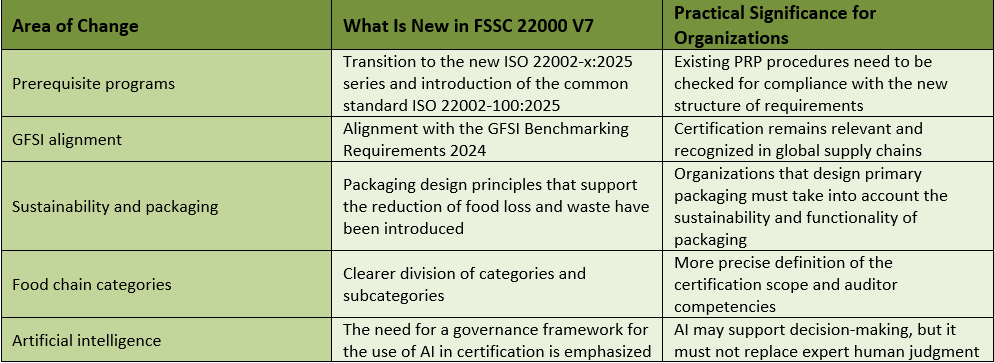
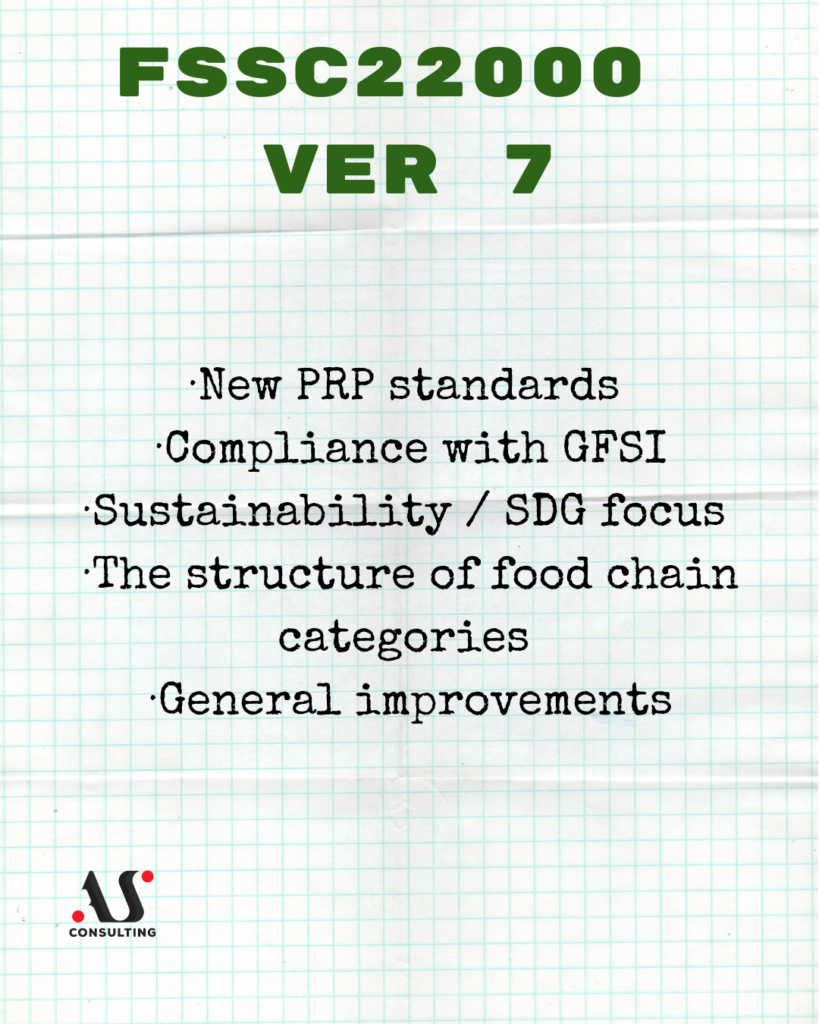
The main reasons for publishing FSSC 22000 V7 are linked to changes in international requirements and practices in the food industry. FSSC states that the key drivers of the revision include the incorporation of the new ISO 22002-x series of prerequisite programs, alignment with the GFSI Benchmarking Requirements 2024, the strengthening of requirements that support organizations’ contribution to the United Nations Sustainable Development Goals, clearer structuring of categories and subcategories in the food chain, as well as the regular improvement and editorial updating of the scheme.¹
In other words, Version 7 seeks to respond to what the market increasingly expects from food safety systems today: greater consistency of requirements, clearer responsibilities, better links with sustainability, and a stronger focus on real risks in production, storage, distribution, packaging, and other activities in the food chain.
The Biggest Change: The New ISO 22002-x Series of Prerequisite Programs
One of the most important new features in FSSC 22000 V7 is the transition from the previous BSI PAS and ISO/TS 22002-x documents to the new ISO 22002-x:2025 series.
The new series introduces ISO 22002-100:2025 as a common, core standard for prerequisite programs that consolidates requirements applicable to different sectors of the food chain. It is applied together with sector-specific parts, for example ISO 22002-1 for food manufacturing, ISO 22002-4 for the manufacture of food packaging, ISO 22002-5 for transport and storage, ISO 22002-6 for the production of animal feed, and other relevant parts.
This change has practical value, particularly for organizations that operate in several sectors or have complex processes. Instead of a fragmented approach, the new structure provides a more unified basis of requirements and a clearer understanding of what is common to all organizations and what is specific to a particular activity.
Focus on Sustainable Packaging and the Reduction of Food Waste
FSSC 22000 V7 introduces a new requirement related to Product Design and Development, particularly in the part concerning sustainable packaging materials. Version 7 includes certain Save Food Packaging Design Principles, developed by the Australasian Institute of Packaging and globalized through the World Packaging Organisation.
These principles are relevant for all FSSC 22000 certified organizations that are involved in the design of primary packaging or packaging materials. This means that packaging is no longer viewed only as a means of product protection and communication with the consumer, but also as an element of the system that can contribute to reducing food loss and waste. Organizations will therefore have to demonstrate that, when developing new products or changing packaging, they consider functionality, safety, sustainability, and the impact of packaging on shelf life and product preservation.
Clearer Category Structure
Version 7 introduces a more clearly defined structure for the division of categories and subcategories in the food chain. This change is not merely technical in nature, because it affects the determination of the certification scope, audit planning, and the selection of competent auditors.
In practice, this may lead to more precise and more relevant auditing. Organizations can expect auditors to pay greater attention to the specific characteristics of their processes, actual risks, and the regulatory context, rather than only to the formal existence of procedures.
Artificial Intelligence: Support, but Not a Substitute for Expert Judgment
One of the more interesting new features is the reference to the use of artificial intelligence in the context of certification. FSSC emphasizes that the use of AI requires an appropriate governance framework that includes ethical, fair, and compliant application, risk assessments, validation, monitoring, and a clear allocation of roles.
Transition Deadlines for FSSC 22000 V7
The transition period has been planned to provide organizations with sufficient time for preparation. According to FSSC, audits against Version 6 are permitted until 30 April 2027, while upgrade audits against Version 7 will be conducted from 1 May 2027 to 30 April 2028.

How to Prepare for the Transition
The first step should be to understand the new requirements and map their impact on the existing system. This does not mean only updating procedures, but also checking whether the changes have truly been integrated into day-to-day operations. It is particularly important to involve teams from production, quality, maintenance, product development, procurement, logistics, and, where applicable, packaging development.
Organizations involved in packaging design should pay particular attention to reviewing how they assess the functionality and sustainability of packaging. Those with complex production or logistics processes should focus on the new structure of prerequisite programs. All certified entities should check whether their programs for Food Defense, Food Fraud, allergens, environmental monitoring, and food safety culture are sufficiently mature, documented, and demonstrable in practice.