
Food Safety Culture: GFSI 2026 – Guidelines and Requirements
April 12, 2026
Rulebook on Amendments to the Rulebook on the Declaration, Labelling and Advertising of Food (“Official Gazette of the Republic of Serbia”, No. 21/2026)
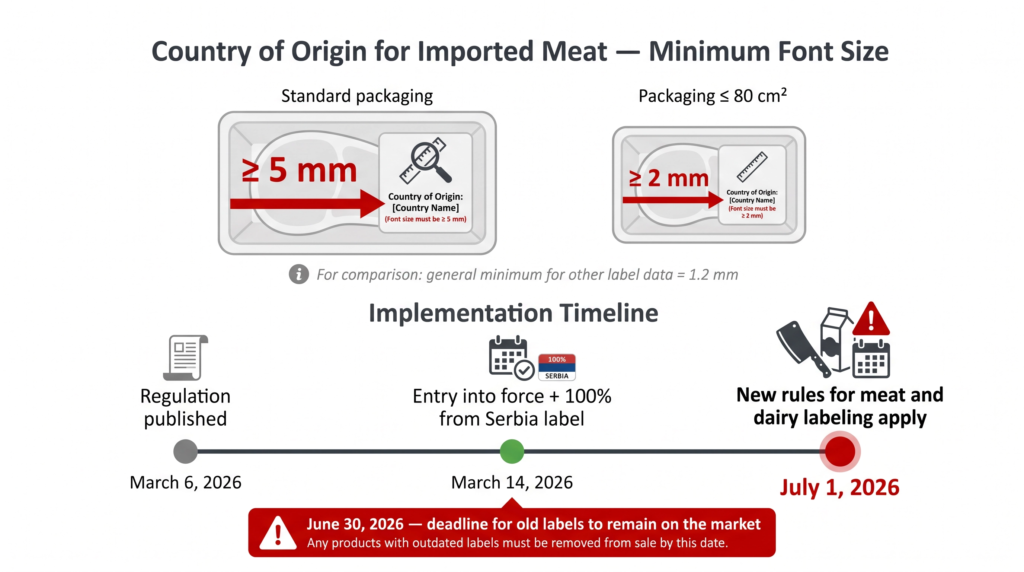
On 6 March 2026, the Rulebook on Amendments to the Rulebook on the Declaration, Labelling and Advertising of Food (Official Gazette of the Republic of Serbia, No. 21/2026) was published in the Official Gazette of the Republic of Serbia. The Rulebook entered into force on 14 March 2026; however, its key provisions will not apply until 1 July 2026, which means that the time available for compliance is short.
The amendments are significant and affect all food business operators — from manufacturers and processors, through importers and distributors, to caterers. Below is an overview of all the changes introduced by this Rulebook.
1. The “100% from Serbia” Graphic Mark — New, Voluntary, but Subject to Penalties if Misused
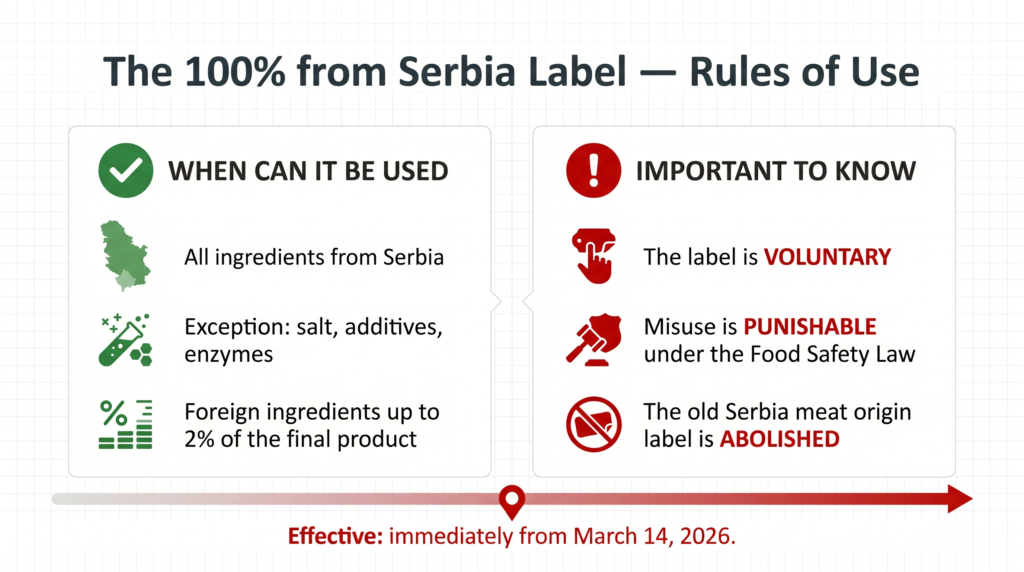
One of the most visible changes is the introduction of the “100% from Serbia” graphic mark. This mark may only be used on products whose all ingredients originate from Serbia, with the exception of salt, food additives and enzymes that, by their very nature, cannot always be sourced from domestic production.
The mark is voluntary — no manufacturer is required to use it. However, any operator who chooses to use it assumes full responsibility for the accuracy of the labelling in accordance with the Law on Food Safety. Penalty provisions apply for incorrect declaration and labelling.
The Rulebook also provides for a practical exception: the mark may be used on products that contain minimal quantities of certain ingredients that cannot be sourced from domestic production, provided that their total share in the finished product does not exceed 2% and that they do not alter the composition, nature or nutritional value of the product.
It is important to note that the new mark also applies to unpackaged products — in such cases, it must be clearly visible and proportionate to the size of the price indication.
At the same time, the Rulebook prescribes the removal of the old graphic mark for meat originating from Serbia, which had previously been displayed alongside meat, meat products or the price indication. This mark is being abolished as it is replaced by the new, unified “100% from Serbia” mark, which applies to all product categories.
2. Stricter Country of Origin Labelling for Imported Meat — Mandatory from 1 July 2026
This is perhaps the most concrete and measurable change in the entire Rulebook. For fresh, chilled and frozen pork, sheep, goat and beef meat, as well as certain beef and poultry products not originating from Serbia, there is now an obligation for the country of origin information to be clearly visible on the label, printed in letters of a prescribed minimum size:

For comparison, the general minimum for standard label information (ingredients, nutritional values) is 1.2 mm for standard packaging. The country of origin of imported meat must therefore be printed in letters more than four times larger than the usual minimum. This represents a significant increase compared to current practice and is intended to ensure that consumers cannot overlook where the meat comes from.
3. Obligation to State the Manufacturer or Processor of Milk — Mandatory from 1 July 2026
A new provision introduces the obligation for the label on milk and dairy products (excluding frozen desserts) to include the name and address of the actual manufacturer or processor of the milk registered in the Republic of Serbia — in cases where the operator placing the product on the market is not also its manufacturer or processor.
The purpose of this measure is transparency: consumers should know who actually processed the milk, not merely who brands and distributes it. Until now, the label often showed only the distributor or brand owner, while the identity of the processor remained unknown.
4. Clearer Obligations for Online Sales and Vending Machine Sales — New Provision
In line with the growth of e-commerce in food products, the Rulebook also introduces specific obligations for online sales and sales via vending machines:
- The seller is required to make all mandatory food information available before the purchase is concluded (before payment).
- The expiry date must be known to the buyer no later than at the time of delivery.
This means it is no longer sufficient for information to be available somewhere on the website — it must be clearly displayed during the purchasing process, before the consumer confirms the order.
5. Responsibilities of Importers and Distributors — Clarification
The Rulebook has clarified responsibilities within the distribution chain:
- If the operator placing food on the market is not registered in the Republic of Serbia, the importer is responsible for all information stated on the label.
- Distributors must not alter information on the label in a manner that could mislead the consumer.
This provision is particularly relevant for importers who repackage or relabel products — any modification must comply with the regulations and must not distort the information provided by the original manufacturer.
6. Clarification of the Definition of “Primary Ingredient”
The Rulebook introduces a more detailed definition of the term “primary ingredient”: it is an ingredient that constitutes more than 50% of the finished product, or an ingredient that the consumer directly associates with the name of the food.
This provision prevents the marketing practice whereby the name of a product suggests the presence of a particular ingredient (e.g. “strawberry yoghurt”, “chocolate spread”), while the actual dominant ingredient is in fact water, sugar or vegetable fats. If the name of a food is linked to a specific ingredient, that ingredient must also be genuinely dominant.
7. Documentation on Allergens for Caterers — Clarification
The Rulebook insists that documentation on ingredients, and in particular on allergens, must be written, up to date and available upon request by the consumer. This directly applies to caterers — restaurants, cafés, catering companies and similar establishments.
It is no longer acceptable for staff to say “we don’t know exactly what is in the dish”. Every caterer must have clear documentation — product specifications and supplier declarations — for every dish on the menu, and must make it available to any guest who requests it.
Overview of Implementation Deadlines

What Does This Mean for Your Business?
If you are a food manufacturer or processor, check whether your labels meet the new requirements — particularly with regard to the letter size for country of origin and the indication of the milk processor.
If you are an importer or distributor, ensure that the labels on imported products comply with the new minimum letter sizes and that responsibility for the accuracy of information is clearly defined in your contracts with foreign suppliers.
If you are a caterer, prepare written allergen documentation for every dish on your menu and ensure that it is accessible to both staff and guests.
If you are an online food seller, adapt your platform so that all mandatory information is displayed before the order is confirmed.
The AS Consulting team is at your disposal for all consultations regarding compliance with the new Rulebook requirements. Contact us and we will review your labels and processes together to ensure you are ready before 1 July 2026.
Source: Rulebook on Amendments to the Rulebook on the Declaration, Labelling and Advertising of Food, Official Gazette of the Republic of Serbia, No. 21/2026, published on 6 March 2026.